
Home
About us
Contact
Make a request
What we supply
Knowledge base
Google rating: 5.0 from 14 reviews★★★★★
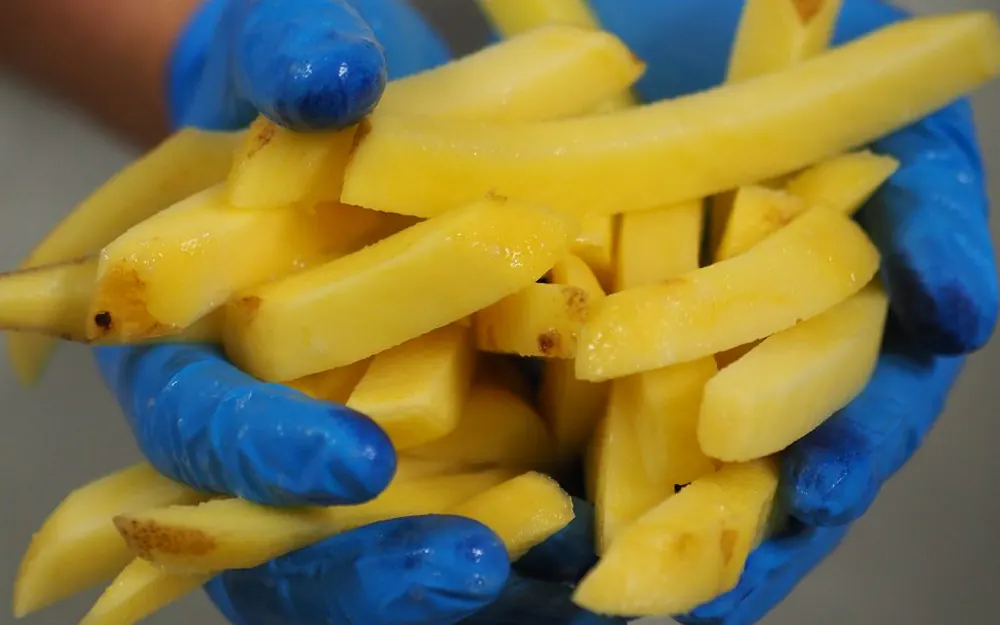
Making chips from fresh potatoes is not difficult, but it takes precision and time. A good chip starts with the right potato and goes through peeling, cutting and frying twice before it reaches the tray. At home you do this for a few people. In a snack bar, chip shop or restaurant it is about many kilos a day, and then every step counts. We have been cutting fresh chips for the hospitality trade since 2016 and grow the potatoes for them ourselves. Below we describe the whole process, and we are honest about how much work making your own chips takes in a business.
Making chips from potatoes starts with the variety. You need a floury potato with plenty of dry matter and little sugar, preferably large and elongated. Agria is the best known choice for this. In August, when the old Agria has been stored for a long time and the new crop is not yet ready, an early variety such as Frieslander is often better. With a waxy or salad potato you will not get a crisp result, however well you work otherwise.
Pay attention to condition too. A chipping potato must be firm, with no green patches, sprouts or soft parts. Potatoes turn green when they are exposed to light, and those green parts must always be removed. Store the potatoes dark, dry and cool, but not in the cold room: potatoes stored too cold turn sweet and brown too quickly in the fryer.
First the potatoes go through water to remove sand and soil. Then comes peeling. At home you use a vegetable peeler; in a business you use an abrasive peeling machine that scrubs the skin off against a rough inner wall. The longer the potatoes spin in the machine, the more of the potato is lost. So set the time carefully and peel slightly too briefly rather than too long.
After the machine, every potato has to be trimmed. Eyes, bits of skin, green parts and blemishes are cut out by hand. This is the job that is underestimated most: it is precise, it takes time and it has to be done again every day. If you are considering a machine, you will find more information under potato peeling machines for catering.
Cut the peeled potatoes into sticks of equal thickness. For the classic Dutch chip that is about 12 by 12 millimetres; Flemish chips are often thicker. Equal thickness matters more than the exact size, because thin and thick chips in one basket are never cooked at the same time. At home you can manage with a knife; in a business you work with a chip cutter. What to look for when buying one is covered in buying a chip cutter, and which cut suits which chip in chip thickness and cut.
Rinsing or soaking is usually not necessary. Only when the potatoes have been stored too cold, or with new crop that has a higher sugar content, can it help to soak the cut chips briefly in cold water. If you do, let them drain well and pat them dry. Wet chips in the fat mean spitting, a temperature that drops and frying fat that deteriorates faster.
Fresh chips are fried twice. First you pre-fry them at a low temperature, about 140 to 160°C, until they are cooked and limp but have hardly any colour. Then let them drain and cool. Just before serving, you finish them at about 175°C until golden and crisp. We explain why both steps are necessary in frying chips twice.
Only salt the chips after frying, in a separate bowl and not above the fryer. Salt in the frying fat speeds up its breakdown. Toss the chips so the salt is evenly distributed, and serve straight away. A chip is at its best in the first few minutes after the final fry.
At home, making your own chips is a nice project for a Saturday afternoon. In a business it is a daily production line. Every day someone has to bring in potatoes, wash, peel, trim and cut them, and then clean the machines, the floor and the drain. This usually happens before opening time or in the quiet hours, and depending on the quantity it takes hours of work every day.
You also need space to store whole potatoes, a peeling machine and a chip cutter, a water supply and drain, and a way of dealing with the peelings. Part of the weight is lost in peeling and trimming, and any sloppiness in trimming shows up on the customer's plate. How to calculate the ratio between kilos bought and portions sold is explained in the yield of fresh chips.
There is an upside too. If you cut your own, you decide the thickness, you can make exactly the amount you need each day and you do not pay for someone else's cutting work. For businesses with their own staff and enough space, that can be the best choice.
Friet van Beus grew out of exactly this trade-off. In 2016 a chip shop near us was tired of peeling and cutting potatoes itself every day. We already had the potatoes, so a peeling and cutting machine came to the farm, and many catering businesses in the area followed. Having your chips cut is smarter if your staff's hours are better spent on customers, if you have little space in the kitchen or if you want consistent quality without having to trim yourself.
We cut our fresh chips on Tuesday and Friday mornings from our own Agria or Frieslander, with no additives and not pre-fried, vacuum packed in 10 kg packs and delivered by our regular drivers. If you would still rather cut your own, we supply the whole potatoes washed, peeled or unpeeled, so you decide how much of the work you keep in house. See also peeled potatoes for catering.
Not sure which route suits your business best? Call or message Thijs on +31 6 23972300 and we will go through the options for your situation together.
Choose a floury potato such as Agria, peel it and cut it into sticks of equal thickness. Make sure they are dry before they go into the fat. Pre-fry at about 140 to 160°C, let them cool and finish them at about 175°C until golden.
This is usually not necessary. Only when potatoes have been stored too cold, or with new crop (higher sugar content), can it help to soak the potatoes briefly in cold water.
A floury, large and elongated potato with plenty of dry matter and little sugar. Agria is the best known choice. In August an early variety such as Frieslander often works better, because it is fully ripe by then.
You save on buying potatoes, but that is offset by labour hours, machines, water, space and peeling loss. Whether it works out cheaper overall depends on your volume and your staff. Do the sums honestly before you choose.
For the classic Dutch chip, about 12 millimetres. Thicker chips have a softer, creamier centre and need a longer pre-frying time. The most important thing is that all chips are equally thick, so they cook evenly.
Call or message Thijs or Joost, or compose your request in a minute. You will hear from us soon.
Make a request Get in touchCall or message Thijs on +31 6 23972300 or Joost on +31 6 23055742, or send an enquiry straight away. We are happy to think along with you.
Make a request Call Thijs: +31 6 23972300