
Home
About us
Contact
Make a request
What we supply
Knowledge base
Google rating: 5.0 from 14 reviews★★★★★
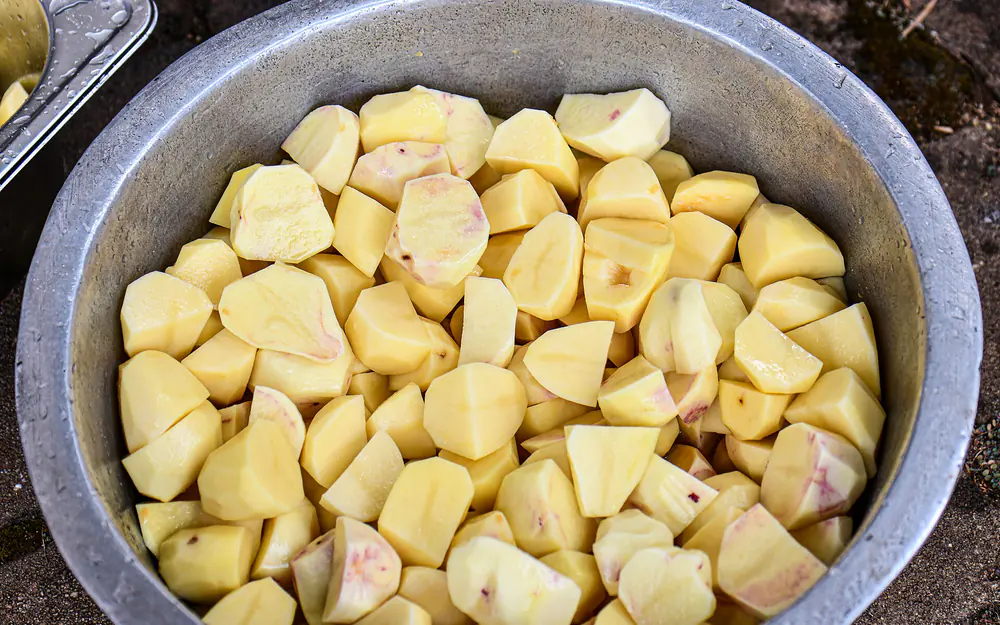
Anyone making fresh chips from whole potatoes needs a potato peeling machine. Peeling by hand is simply not feasible at catering volumes. But a peeler is also an investment in space, water and maintenance, and not every machine suits every business. We work with a scraping and cutting machine on our own farm and know what is involved. Below you can read how a potato peeling machine for catering works, what to look for when buying one and what the alternative is.
Most catering peelers work by abrasion. The inside of the drum and the rotating base plate are lined with carborundum (silicon carbide), a hard, rough material that resembles very coarse sandpaper. As the plate turns, the potatoes tumble through the drum and rub against the rough wall and against each other. Layer by layer the skin comes off.
While it turns, water runs into the drum. It flushes the peel away through the outlet and keeps the potatoes cool and clean. After a few minutes you open the hatch at the front and the peeled tubers roll into a tub. Deep eyes and damaged spots are not always reached by the machine. You cut those out afterwards with a small knife. This is called trimming.
There are also machines with brushes or rollers instead of carborundum. Those are mainly meant for washing or light scraping, rather than full peeling.
Capacity is usually stated in kilos per load and in kilos per hour. A small bench model handles a limited amount at a time, a floor standing model takes considerably more. The hourly figure assumes you load one batch after another. In a kitchen where the same person also has to cut and fry, the real pace is lower.
So look beyond the number to your workflow. How many kilos of potatoes do you peel on a busy day, and how do you spread that over the day? Is there room for a floor model with a drain nearby? Will the machine run on a normal socket or does it need three phase power? And does the output line up well with your chip cutter, so you can keep working without much lifting?
A peeler does not only remove the skin, it also takes off part of the potato. The longer a batch runs, the more you lose. It is tempting to let a batch run half a minute longer so there is less trimming, but over time that costs a lot of kilos. Match the running time to the variety and the size of the tubers.
The potato itself makes a big difference. Large, even tubers with shallow eyes lose proportionally less than small, irregular ones. Grading counts too: small tubers among the large ones are stripped bare before the large ones are done. That is why chip fryers like a variety such as Agria, with large, elongated tubers and shallow eyes, and a batch that has been well graded.
The peelings themselves have to go somewhere too. They are wet, heavy and spoil quickly. Think about collection, storage and disposal before you buy the machine.
A peeler uses water continuously while it runs. That water comes out full of starch and fine peel particles. Without the right provisions your drain will clog sooner or later. A peel trap or strainer between the machine and the drain catches the coarse material and is a sensible addition for many businesses.
Clean the machine after every use: drum, plate, hatch and outlet. Potato residue and starch left behind start to smell and attract bacteria. The carborundum wears over time and then abrades less well, so the running time per batch creeps up. So check the plate and the wall regularly and have them replaced in time. Include the cleaning in your hygiene plan as well.
For chips the whole skin does not always have to come off. With scraping only a thin layer is removed, so a little skin remains here and there. That gives a rustic look and less loss. For skin on chips or farmhouse chips you simply wash the potatoes well and cut them skin and all.
If you want neat yellow chips without any peel, you peel the potatoes fully and trim eyes and blemishes. Which approach suits your menu best also decides which machine you need: a light scraper or a heavy duty peeler.
Owning a peeler means investing in equipment, space, water and above all hours. For many business owners that is the reason to outsource the peeling. That is how Friet van Beus started too: in 2016 a local chip shop was fed up with peeling and cutting its own potatoes. We bought a scraping and cutting machine and took that work off their hands.
You decide how much of the work you hand over. Whole potatoes, washed and scraped, so all that is left is cutting. Or fresh chips, cut from our own Agria or Frieslander on Tuesday and Friday mornings, vacuum packed in 10 kg packs and delivered by our regular drivers. More information is available under peeled potatoes for catering. Want to know what makes most sense for your business? Call or message Thijs or Joost.
A rotating plate makes the potatoes tumble through a drum lined with carborundum, a rough abrasive. The skin is rubbed off and flushed away with water. Deep eyes are cut out by hand afterwards.
That depends on the variety, the size and shape of the tubers and how long a batch runs. Large, even tubers with shallow eyes and a short running time give the least loss.
For most businesses it is sensible. The rinse water contains a lot of starch and peel that can block the drain. A trap or strainer holds back the coarse material.
With scraping only a thin layer of skin is removed and small bits of skin remain. With peeling the skin comes off completely and eyes and blemishes are trimmed.
Yes. Friet van Beus supplies whole potatoes washed or scraped, as well as freshly cut chips. Contact Thijs or Joost to discuss the options.
Call or message Thijs or Joost, or compose your request in a minute. You will hear from us soon.
Make a request Get in touchCall or message Thijs on +31 6 23972300 or Joost on +31 6 23055742, or send an enquiry straight away. We are happy to think along with you.
Make a request Call Thijs: +31 6 23972300