
Home
About us
Contact
Make a request
What we supply
Knowledge base
Google rating: 5.0 from 14 reviews★★★★★
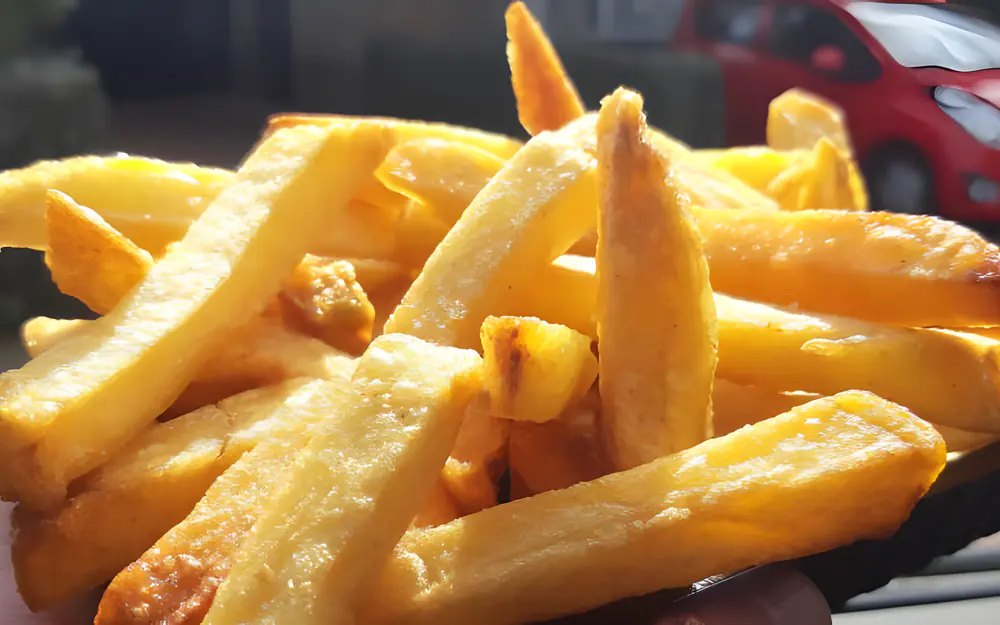
Farmhouse chips, boerenfriet in Dutch, appear on more and more menus, from the snack bar on the corner to the restaurant with its own kitchen. But what exactly are they? The name promises something traditional: thicker chips, rustically cut, sometimes with the skin still on. Yet the name says little about where the potato comes from. Here you can read what farmhouse chips usually means, how to fry them well in your business and why chips from the farm should literally come from a farmer.
Farmhouse chips is not a protected name. There is no rule about how thick they must be or which variety must be used. In practice most businesses and suppliers mean chips that are coarser and thicker than standard snack bar chips, with a rustic look. The sticks are not always exactly equal, the edges may be a little irregular and the skin is often left fully or partly on.
The result on the plate is easy to recognise: a crisp outside with a soft, floury inside, and more potato flavour per bite because the balance between crust and centre is different. That firm bite is exactly why farmhouse chips are popular with dishes such as stew, spare ribs or a burger, where thin chips are easily lost next to everything else on the plate.
Many frozen farmhouse chips come from large factories. Potatoes from many different growers are processed there, cut into a rustic shape, pre-fried and frozen. Sometimes the chips are given a coating for extra crispness. There is nothing wrong with that, but the farmer is then mainly a picture on the packaging. The name refers to how the chips look, not to where they come from.
Real farmhouse chips come from the farmer who grows the potato. That is how it works with us. Since 1994 we have grown potatoes on our farm in Zeewolde, alongside sugar beet, onions and winter wheat. In 2016 a nearby chip shop had had enough of peeling and cutting potatoes itself. That was the starting signal: a scraping and cutting machine arrived and Friet van Beus was born. We only cut our own potatoes, with no additives and not pre-fried. What that difference means is explained under potatoes from the farmer.
For thick chips you need a potato with a high dry matter content and little sugar. Plenty of dry matter gives a floury centre that does not turn watery or glassy. Low sugar stops the chips from darkening too quickly, which matters even more with thick chips because they spend longer in the fat. Large, elongated tubers are useful, because you can cut long, even sticks from them without much waste.
Our Agria potatoes meet those requirements well. From September to July we cut our chips from Agria. In August, the transition season, we switch to Frieslander for a few weeks, an early variety with a floury texture. Because we only use our own potatoes, you will notice hardly any difference in quality throughout the year.
Thicker chips need patience in the fryer. Pre-fry them at a lower temperature and take your time, so the centre is fully cooked before any colour appears. Then let the chips steam off briefly and finish them just before serving until golden and crisp, at no more than 175 degrees. Do not put too many chips in the basket at once, as the temperature drops and the chips turn limp and greasy.
If you opt for skin-on farmhouse chips, scrub the potatoes thoroughly and cut away green patches and damage. You can read more about that variation under skin-on chips. If you want to experiment with thickness, see our explanation of chip thickness and cut. A pinch of coarse salt straight after frying finishes them off.
Guests increasingly want to know where their food comes from. That is an opportunity for your business. A line on the menu such as 'fresh chips from potatoes grown in Zeewolde' says more than the word farmhouse alone, and you can back it up. The story of a family business where the third generation works alongside, with the potato going from its own fields into the vacuum bag, is exactly what the name promises.
At Friet van Beus we cut on Tuesday and Friday mornings and our regular drivers then deliver throughout the central Netherlands, from Zeewolde and Almere to Harderwijk, the Amsterdam area and Apeldoorn. Prefer to cut your own farmhouse style? You can also buy whole potatoes: washed or scraped, and those can be delivered nationwide. Call or message Thijs on 06 23972300 or Joost on 06 23055742, or send a request straight away.
Farmhouse chips are thicker and more rustic than ordinary snack bar chips, often coarsely cut and sometimes skin-on. The name is not protected, so the exact thickness and the origin of the potato vary by supplier.
No. Many farmhouse chips do have skin, but it is not a requirement. The rustic look and the thicker cut matter more than the skin.
Farmhouse chips are thicker and more coarsely cut. As a result they have relatively more soft centre and a firmer bite. They also need a longer pre-fry at a lower temperature.
In the literal sense, yes: we cut them from potatoes we grow ourselves on our farm in Zeewolde, with no additives and not pre-fried. We are happy to discuss thickness and the options for your business.
Friet van Beus supplies businesses only, such as snack bars, chip shops, restaurants, food trucks, events and wholesalers. Collection by appointment is possible if needed.
Call or message Thijs or Joost, or compose your request in a minute. You will hear from us soon.
Make a request Get in touchCall or message Thijs on +31 6 23972300 or Joost on +31 6 23055742, or send an enquiry straight away. We are happy to think along with you.
Make a request Call Thijs: +31 6 23972300