
Home
About us
Contact
Make a request
What we supply
Knowledge base
Google rating: 5.0 from 14 reviews★★★★★
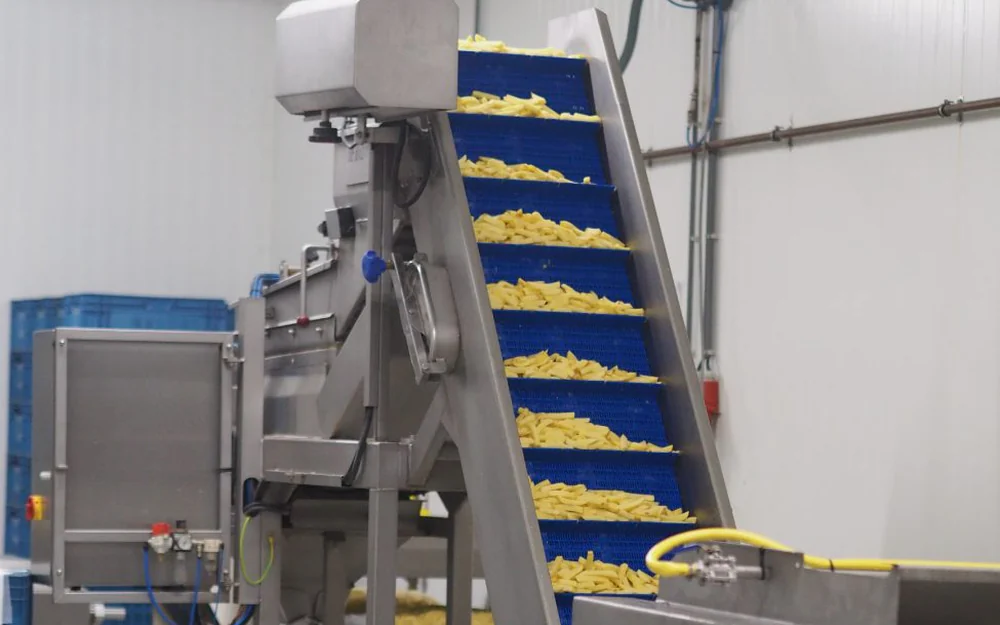
Cutting chips looks like a simple task, but the thickness you choose largely determines how your chips taste, how long they need in the oil and how they look in the tray. Whether you are cutting thin fries for a chip shop or thick chips for a restaurant, it pays to choose deliberately. On this page we set out the common sizes and their effect. This is general trade knowledge: the sizes are customary in the trade, not fixed standards.
As its classic size, Friet van Beus works with about 12 by 12 millimetres. That gives a chip with a crisp crust and a full, soft centre that is easy to portion during busy service and does not cool too quickly. Thinner fries of around 10 millimetres are also common: quicker to cook, with slightly more crust. Thinner still, around 7 millimetres, are thin fries or shoestring. Those are extra crisp, but also colour too dark more quickly and are less forgiving during busy service.
Around the same size or slightly thicker, at 12 to 13 millimetres, are Belgian-style chips: plenty of potato, a soft centre and a firm bite. Coarser still are steakhouse chips, often cut from around 14 millimetres, sometimes with the skin on. Leave the skin on with a coarse cut and you move towards farmhouse chips.
The thinner the chip, the more surface per kilo of potato. More surface means more crust, so a crisper chip, but also more oil clinging to it and a shorter frying time. Thin chips also cool faster, which you notice with takeaway and delivery.
Thick chips work the other way round. There is proportionally less crust and more soft potato, the potato flavour comes through more strongly and the chips stay warm longer. Blanching does take longer, because the heat needs more time to reach the core. With a thick cut, frying in two stages is therefore essential. The temperature to blanch at is explained under blanching temperature for chips.
If you cut your own, the cutter determines the size. With a manual wall-mounted chip cutter or an electric machine you swap the blade set for a different thickness. Keep the blades sharp: a blunt blade bruises the potato, gives ragged edges and releases more starch and moisture. What to look for when buying one is explained under buying a chip cutter.
You do not set the length of your chips with the blade but with the potato. Long tubers give long chips. That is one of the reasons Agria is so popular in the chip kitchen. Rinse cut chips briefly to remove loose starch and let them drain well before they go into the oil.
No single cut is best for every business. If you mainly do fast takeaway with many portions an hour, a classic thickness is practical: short time in the oil and familiar to guests. If you deliver a lot, a slightly thicker chip holds its heat better on the way. If you serve chips as a side with a plated dish in a restaurant, a coarser cut often suits the presentation better.
Choose one cut and stick to it, so your staff get the frying times in their fingers and your guests get the same every time. If you want to know which cut we can supply for you, ask Thijs about the options on 06 23972300. You can also buy whole potatoes and cut them yourself.
Friet van Beus treats about 12 by 12 millimetres as the classic size. Thinner fries of around 10 millimetres are also common. There is no fixed standard.
Belgian-style chips are often cut at 12 to 13 millimetres, sometimes thicker. That is close to the classic 12 millimetre size and gives a soft centre with plenty of potato flavour.
Yes. Thick chips need longer when blanching because the heat takes longer to reach the core. Thin chips are ready sooner, but also colour too dark sooner.
Ask Thijs or Joost about the options. You can also buy whole potatoes from us, washed or scraped, and choose your own cut.
Call or message Thijs or Joost, or compose your request in a minute. You will hear from us soon.
Make a request Get in touchCall or message Thijs on +31 6 23972300 or Joost on +31 6 23055742, or send an enquiry straight away. We are happy to think along with you.
Make a request Call Thijs: +31 6 23972300