
Home
About us
Contact
Make a request
What we supply
Knowledge base
Google rating: 5.0 from 14 reviews★★★★★
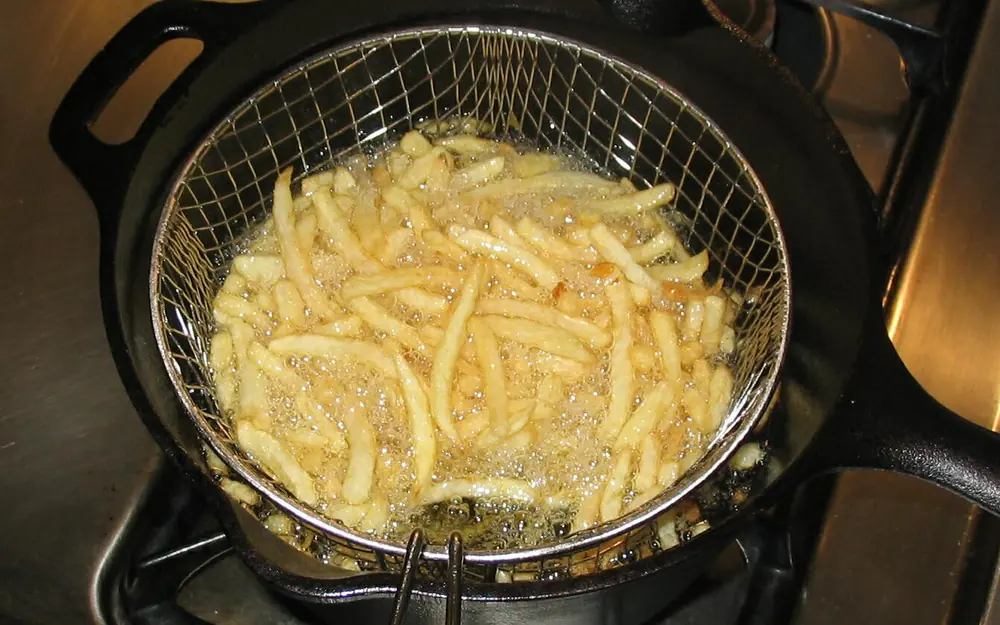
The right frying temperature is the difference between a pale, limp portion and chips that are fluffy inside and crisp outside. Pre-frying in particular often goes wrong: too hot and the outside colours before the centre is cooked, too cool and the chips soak up fat. This page gives the figures commonly used in catering for fresh chips, with attention to thickness of cut, oil and acrylamide. The general method is covered under pre-frying chips; here the focus is on temperature and time.
Fresh chips are fried in two stages. The pre-frying temperature is 150 to 160°C, and finishing is done at 170 to 175°C. The time depends mainly on thickness. For the classic cut of about 12 millimetres, the size Friet van Beus treats as standard, the guideline is: pre-fry at 160°C for 4 to 6 minutes, until the chips are cooked through but have not taken on colour. Finish at 175°C for 2 to 3 minutes, until golden and crisp.
A thinner cut, around 10 millimetres or finer, is quicker: pre-fry at 160°C for 2 to 3 minutes and finish at 175°C for 1.5 to 2 minutes. A thick cut, such as steakhouse chips, is pre-fried at around 150°C for longer, 6 to 8 minutes, so the centre cooks through. Then finish at 175°C for 3 to 4 minutes. Treat these temperatures as a starting point and taste your own chips.
Allow a pause between pre-frying and finishing. Let the pre-fried chips drain and cool, as a guide for at least a quarter of an hour, so the surface dries and the crust forms better when finishing. Why that works is explained under frying chips twice.
Heat has to travel from the outside to the centre. With a thick cut that distance is longer, so the inside needs more time to cook. Fry a thick chip at the same temperature as a thin one and the outside colours before the middle is soft. With a thin cut the risk is the other way round: it dries out quickly and turns hard if left in too long.
Keep a separate routine for each cut and never mix thicknesses in one basket. If you cut your own, make sure all the chips are the same thickness; uneven chips give a basket in which some are too dark and others too pale. More about choosing a cut can be found under chip thickness and cut.
The temperature on the dial is not the temperature in the fryer. As soon as you lower a full basket of cold chips, the fat temperature drops sharply. The fuller the basket and the smaller the tank, the bigger the drop and the longer it takes to recover. At busy times, fill the basket halfway more often rather than to the brim once. A fryer with enough power holds its temperature better.
The fat itself counts too. Fresh fat fries differently from fat that has been in use for days; older fat browns chips more quickly. Check your fryer's thermostat now and then with a separate thermometer. Which fat to choose is covered under the best frying fat.
Acrylamide forms when starchy foods such as chips brown at high temperatures. European rules for catering therefore ask you not to fry chips hotter than 175°C and to stop at a golden yellow colour, not brown. It also helps to use potatoes low in sugars and not to store them below 6°C, because cold raises the sugar content of the potato. More background can be found under acrylamide in chips.
Fresh chips from home-grown Agria and Frieslander are supplied without additives and are not pre-fried, so the colour is entirely in your hands. Would you like help tuning your frying routine to these chips? Call or message Thijs on 06 23972300.
As a guide at 150 to 160°C, depending on thickness. The chips should be cooked through without taking on colour.
Between 170 and 175°C. Going above 175°C is advised against because of acrylamide; fry until golden yellow.
Often the temperature is too high, the fat is too old, or the potato contains a lot of sugar, for example because of cold storage. Check your thermometer and your fat.
Sometimes. A variety high in dry matter fries and colours differently from a watery one. When the switch from Agria to Frieslander comes in August, and back again a few weeks later in September, it is worth running through your routine again.
Call or message Thijs or Joost, or compose your request in a minute. You will hear from us soon.
Make a request Get in touchCall or message Thijs on +31 6 23972300 or Joost on +31 6 23055742, or send an enquiry straight away. We are happy to think along with you.
Make a request Call Thijs: +31 6 23972300