
Home
About us
Contact
Make a request
What we supply
Knowledge base
Google rating: 5.0 from 14 reviews★★★★★
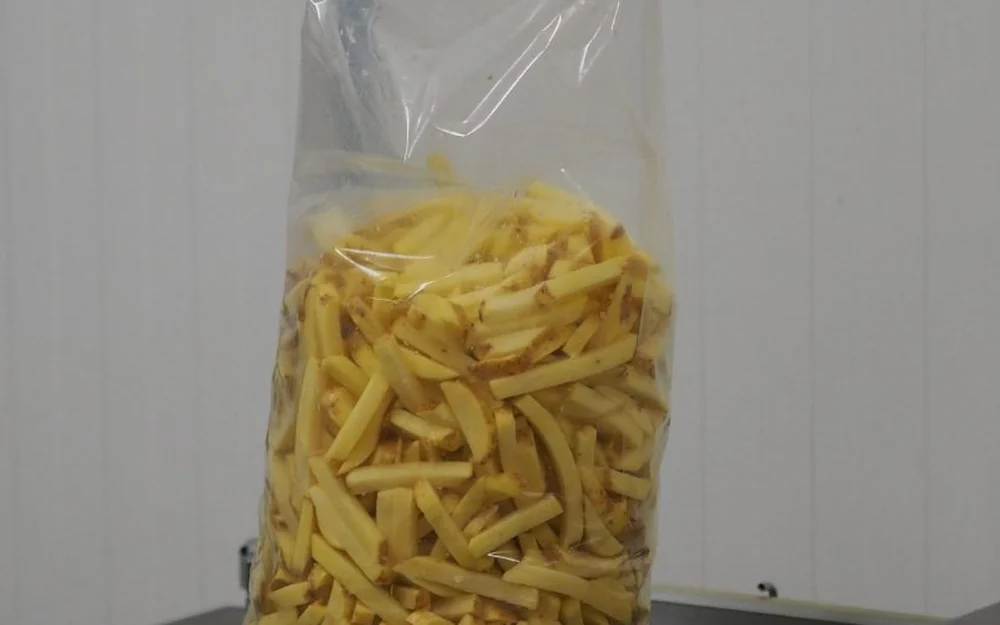
Finishing is the moment the customer gets to know your chips. After pre-frying the chips are cooked but still pale and limp. In the second fry, at about 175°C, they quickly take on their golden colour and crisp crust. It looks like the easiest step, but this is exactly where a lot goes wrong during the rush. In this article you will read at what temperature to finish, how to recognise the right moment, how to salt and serve, and how to keep your timing tight behind the counter.
The final fry is all about the outside. The pre-fried chip has a dried surface. In the hot fat the last moisture on the outside evaporates very quickly and a thin, crisp layer forms. At the same time the chip turns golden through the reaction between sugars and proteins. The inside is already cooked and stays soft and fluffy, protected by that crust.
Because the inside is already cooked, the final fry does not need to take long. It is a short, fierce step. How well it turns out depends largely on what came before: the right potato and properly carried out pre-frying. A chip that came out of the first fry too dark cannot be rescued in the final fry.
For the final fry you set the fryer to about 175°C. That temperature is hot enough for a quick, crisp crust and low enough to keep the chips from turning too dark. Going higher makes little sense: the chips then colour faster than they crisp up and you get a brown, bitter outside.
There is another reason not to go above 175°C. Frying starchy foods at high temperatures produces acrylamide, a substance you want to keep as low as possible. The darker the chip, the more acrylamide. European rules therefore require chip shops to take measures, such as not frying too hot and keeping an eye on the colour. More on this in acrylamide in chips.
The final fry usually takes only a few minutes, often around 2 to 3 minutes for regular chips. But just as with pre-frying, the clock is only a guide. Look at the colour: you want evenly golden chips, not light brown and certainly not dark at the tips. Many businesses hang a colour chart next to the fryer so everyone on the team works to the same colour.
Sound helps too. When the chips go into the fat, it bubbles and hisses fiercely. As the surface becomes dry and crisp, the bubbling dies down. Shake the basket once halfway through, so the chips separate and colour evenly all over.
After the final fry, let the basket drain above the fryer for a few seconds and give it a quick shake so the excess fat runs off. Then tip the chips into a bowl or chip tray. Salt immediately, because salt sticks best to hot chips. Do not do this above the fryer: salt falling into the fat speeds up its breakdown.
Toss the chips after salting so the salt is evenly spread and not just sitting on top. Serve as quickly as possible. Fresh chips are at their best in the first few minutes; do not leave them under a heat lamp until they have lost their crispness. If a portion has to wait, it is better to finish it a little later.
In a busy business, finishing is a matter of rhythm. Keep enough pre-fried chips ready by the fryer so you never have to wait for a pre-fry when there is a queue at the counter. Finish in portions that match the orders; it is better to do half a basket more often than a full basket that sits around too long.
Mind your fryer's recovery time. After every basket the temperature drops; let it return to 175°C before the next basket goes in. Lower two baskets into the same fryer straight after each other and you get greasy, limp chips. If you work with several fryers, divide the tasks: one for pre-frying, one or more for finishing. That keeps the temperatures stable.
Frying fat that is used for too long behaves differently: it foams, smells stronger and the chips colour faster and absorb more fat. Keep the fat topped up, filter it daily and change it in time. How to keep track of this is explained under changing frying fat. If you are unsure which type of fat to use, see beef dripping or vegetable frying fat.
Limp chips after the final fry usually mean the temperature was too low or the basket too full. Chips that are too dark point to too high a temperature, finishing for too long, old fat or potatoes with too much sugar. Greasy chips are often caused by a fryer that was not up to temperature, or by chips that were not able to drain properly after frying.
If the result keeps disappointing while the temperatures are right, look at the potato and the fat. A good chipping variety that has been stored properly makes the final fry a lot more forgiving. What we think makes the difference between good chips and truly delicious chips is described separately.
We help business owners choose the right oil or frying fat and adjust their way of working, so the chips come out of the fryer perfectly. Read more about our advice on frying chips, or call or message Thijs on +31 6 23972300.
At about 175°C. That gives a quick, crisp crust and a golden colour. Going higher makes no sense: the chips then darken too quickly and more acrylamide forms.
Usually a few minutes, often around 2 to 3 minutes for regular chips. Watch the colour above all: evenly golden is right. The bubbling of the fat calms down once the chips are crisp.
Straight after finishing and draining, in a bowl and not above the fryer. Salt sticks well to hot chips. Toss the chips so the salt is evenly distributed.
Usually the fryer was not up to temperature or the basket was too full, so the temperature dropped too far. Chips that stand too long after frying also lose their crispness. Fry smaller portions and serve immediately.
The temperature is similar, but fresh chips must first be pre-fried and cooled by you. Frozen chips have already been pre-fried in the factory and go straight from the freezer into the fryer.
Call or message Thijs or Joost, or compose your request in a minute. You will hear from us soon.
Make a request Get in touchCall or message Thijs on +31 6 23972300 or Joost on +31 6 23055742, or send an enquiry straight away. We are happy to think along with you.
Make a request Call Thijs: +31 6 23972300