
Home
About us
Contact
Make a request
What we supply
Knowledge base
Google rating: 5.0 from 14 reviews★★★★★
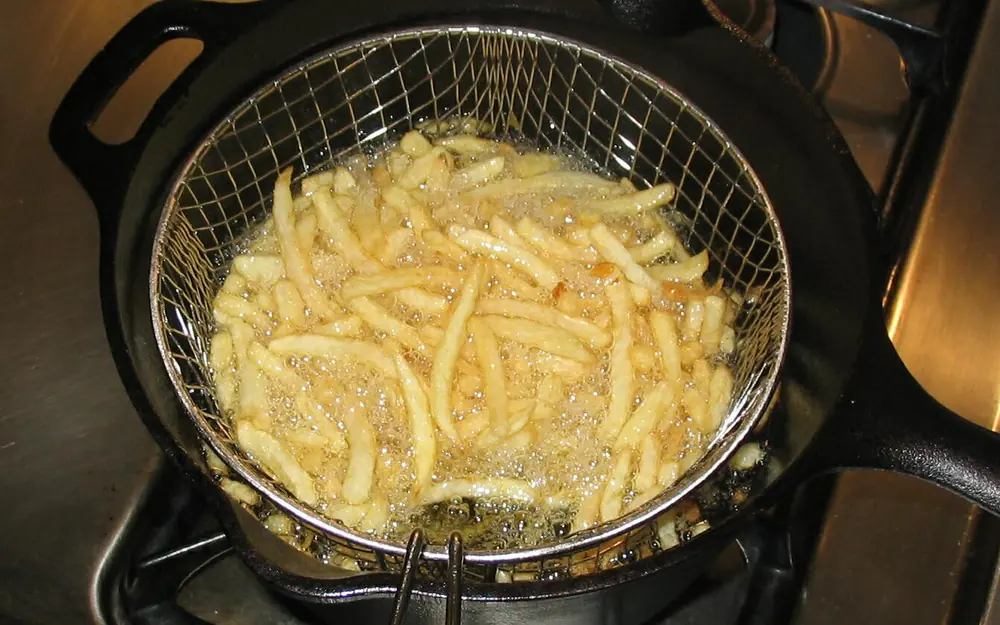
Anyone who runs a chip shop gets the question sooner or later: what is the best frying fat? The honest answer is that no single fat wins in every kitchen. There is, however, a best choice for your business, depending on how much you fry, which guests you serve and which flavour you want on the plate. As growers who regularly talk to chip shops about their fryers, we set out the types, smoke point, flavour and stability for you.
Solid vegetable frying fat has been the standard in Dutch snack bars and chip shops for decades. It is usually based on palm fat, is solid at room temperature and melts into a clear liquid in the fryer. Its big advantage is stability: the fat can stay at temperature for a long time without breaking down quickly, and it gives chips a dry, crisp crust. Because it sets again as it cools, chips in a bag or tray feel less greasy.
Liquid frying oil is the other family. Think of sunflower oil, rapeseed oil and palm olein, the liquid fraction of palm oil. Oil is easy to top up, does not need melting first and gives a lighter mouthfeel. Do pay attention to the type. Ordinary sunflower oil contains a lot of polyunsaturated fatty acids and breaks down quickly in a busy fryer. For professional use there are dedicated frying oils with a high oleic acid content, often labelled high oleic, which last much longer.
Palm deserves a separate note. It is stable and widely available, but its origin is a sensitive subject for some guests. If that matters to your business, ask your fat supplier where the palm comes from and how that is managed.
In Belgium many chip shops traditionally fry in beef dripping, also known as blanc de boeuf. Beef dripping gives chips a full, slightly savoury flavour and a crisp outside that enthusiasts recognise as proper Belgian frites. In the Netherlands, too, some businesses serving fresh chips choose beef dripping or a blend of dripping and vegetable fat, precisely to stand out from the rest.
There are drawbacks too. Beef dripping is not suitable for vegetarians or for guests who do not eat beef fat for religious reasons. It smells stronger in the shop and in the extraction system, contains a lot of saturated fat and sets quickly, which calls for extra care when filtering and disposing of it. If you are unsure, read the trade-offs in our piece on beef dripping or vegetable frying fat. Either way, state your choice clearly on the menu so guests know where they stand.
The smoke point is the temperature at which fat starts to smoke visibly and break down. Refined frying fats and oils sit well above 200 degrees, so with fresh fat you stay far below it during normal frying. The smoke point does drop as the fat ages, though. If your fryer smokes at a temperature where it did not before, that is a clear sign the fat is finished.
Stability determines how long the fat lasts. Fats rich in saturated and monounsaturated fatty acids, such as solid palm fat, beef dripping and high oleic oils, oxidise more slowly than oils high in polyunsaturated fatty acids. Watch for the signs of breakdown: a dark colour, foam that does not settle, a sharp or rancid smell and chips that brown faster than you are used to.
Flavour is the third factor. Vegetable fat is neutral and lets the potato speak, while beef dripping adds flavour of its own. Whichever fat you choose, finish frying at no more than 175 degrees until golden yellow. That not only tastes better, it also keeps acrylamide formation low, as we explain under acrylamide in chips.
Fresh chips, cut from raw potatoes, bring more moisture and starch into the fryer than pre-fried frozen chips. Moisture speeds up the breakdown of fat, and loose starch particles burn on the bottom of the fryer. So make sure fresh chips go into the basket well drained and as dry as possible. The drier the chips enter the fat, the calmer the fryer bubbles and the longer your fat lasts.
Fresh chips are also fried in two stages: first a pre-fry at a lower temperature, then a finishing fry until crisp. That is why many businesses work with two fryer tanks, each at its own temperature. You can read the method in frying chips twice. Filter the fat daily, skim off crumbs in between and keep to a fixed schedule for changing your frying fat. That makes more difference than switching brands.
At Friet van Beus we help customers choose the right oil or frying fat. We always start with the same questions. How many portions do you fry on a busy evening? Do you work with one fryer or with separate tanks for pre-frying and finishing? How many vegetarian guests do you serve? And do you want the chips themselves to carry the flavour, or are you after the full taste of beef dripping?
For a business that fries large volumes and wants to stay neutral, a stable solid vegetable fat or a professional high oleic oil is the obvious choice. A business that wants to stand out with Flemish-style chips might consider beef dripping or a blend. Whichever way you go, the difference lies just as much in the method: the temperature, the amount of chips per basket and how you look after the fat. We are happy to think along, see also our advice on frying chips.
Would you like to talk about fat in combination with our fresh chips? Call or message Thijs on 06 23972300 or Joost on 06 23055742. You are also welcome at the farm in Zeewolde to see where your potatoes come from.
No single fat is best for every business. Solid vegetable frying fat is stable and neutral, which is why it is the standard in many snack bars. Beef dripping adds more flavour, and professional high oleic oils are easy to use and last a long time. Choose based on your volume, your guests and the flavour you are after.
You can, but ordinary sunflower oil breaks down quickly during prolonged frying because of its high polyunsaturated fat content. For a professional fryer, a dedicated frying oil with a high oleic acid content is a better choice.
Finish chips at no more than 175 degrees until golden yellow. The pre-fry is done at a lower temperature. Frying hotter does not make the chips better, only darker, and it increases acrylamide formation.
Look for a dark colour, foam that does not settle, smoke at a normal frying temperature, a sharp or rancid smell and chips that brown too quickly. If you notice one or more of these signs, change the fat.
Yes. We help you choose the right oil or frying fat and think along about the way you work in your kitchen, so our fresh chips come out of the fryer perfectly. Call or message Thijs or Joost.
Call or message Thijs or Joost, or compose your request in a minute. You will hear from us soon.
Make a request Get in touchCall or message Thijs on +31 6 23972300 or Joost on +31 6 23055742, or send an enquiry straight away. We are happy to think along with you.
Make a request Call Thijs: +31 6 23972300