
Home
About us
Contact
Make a request
What we supply
Knowledge base
Google rating: 5.0 from 14 reviews★★★★★
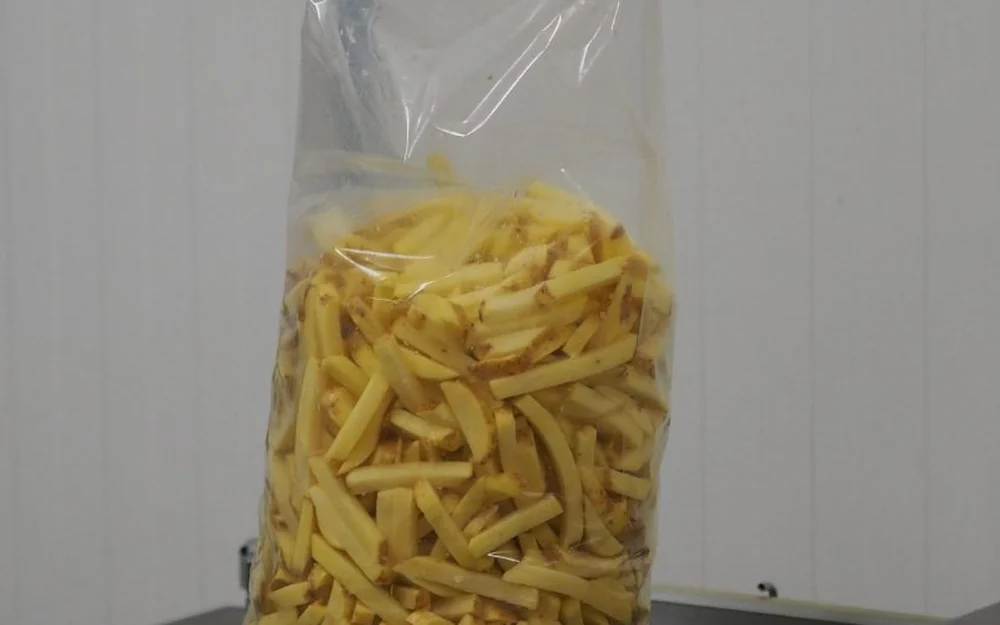
Frying chips twice is standard practice in Dutch and Belgian chip culture, and for good reason. Try to cook fresh chips through and brown them in one go and you get chips that are dark outside while still raw inside, or chips that come out of the basket limp and greasy. Double frying solves that. Below you can read what happens inside the potato and how to use that principle in your own kitchen.
A raw potato is mostly water, with starch granules in between. In the first fry, at a moderate temperature, the chip heats right through to the centre. There the starch absorbs moisture, swells and sets; this is called gelatinisation. It gives the inside the soft, fluffy texture you know from good chips.
At the same time some of the water at the surface evaporates. A thin, drier layer forms, but no crust yet and hardly any colour. The temperature is deliberately kept moderate: that gives the centre time to cook before the outside browns.
After the first fry you let the chips drain and cool. During that time steam escapes from the chips and the surface dries further. As it cools, the gelatinised starch on the outside firms up. That layer will later form the basis of the crust.
Chips that go straight from the first fry into the second stay moister on the outside. That moisture has to go before a crust can form, so the chips spend longer in the fat and absorb more of it. A resting period therefore gives you chips that are not only crisper but also less greasy.
In the second fry the chips go into the fat briefly at a higher temperature. The remaining moisture at the surface evaporates within seconds and the outer layer turns hard and crisp. Sugars and proteins in the potato react with each other to give the golden colour and full flavour; this is the Maillard reaction. Keep finishing to a maximum of 175°C and stop at golden yellow, because of acrylamide.
Because the centre is already cooked, the second fry only needs to be short. That is exactly what makes the method so well suited to catering: the time-consuming part is done in advance. Guide temperatures and times per cut can be found under pre-frying chips: temperature and time.
In a busy snack bar double frying is not an extra burden but a way of coping with the rush. Before the peak you pre-fry a stock of chips that waits on a rack or in trays. When an order comes in, a portion goes into the second fry and is in the tray within a few minutes. That keeps waiting times down, even when the queue reaches the door.
Keep the stock of pre-fried chips in proportion to the expected rush, and put anything not needed straight away in the cold room, covered. If possible, work with two tanks at different temperatures so you never have to wait for the fat to come up to heat. The general method is covered under pre-frying chips and finishing chips. Fresh chips from Friet van Beus are not pre-fried and are therefore made for exactly this approach; if you would like to try them, send us a request.
We advise against it with fresh chips. The outside colours before the centre is cooked, or the chips turn limp and greasy.
Until they have drained well and cooled, as a guide a quarter of an hour or longer. Many businesses pre-fry a batch at the start of the shift.
Often the finishing fry is too short, the fat is not hot enough, or the chips have not rested long enough. Salt also draws out moisture; add it in the tray, not over the fryer.
Frozen chips are usually pre-fried at the factory and then frozen, so you only do the second fry. With fresh chips you do both fries yourself.
Call or message Thijs or Joost, or compose your request in a minute. You will hear from us soon.
Make a request Get in touchCall or message Thijs on +31 6 23972300 or Joost on +31 6 23055742, or send an enquiry straight away. We are happy to think along with you.
Make a request Call Thijs: +31 6 23972300