
Home
About us
Contact
Make a request
What we supply
Knowledge base
Google rating: 5.0 from 14 reviews★★★★★
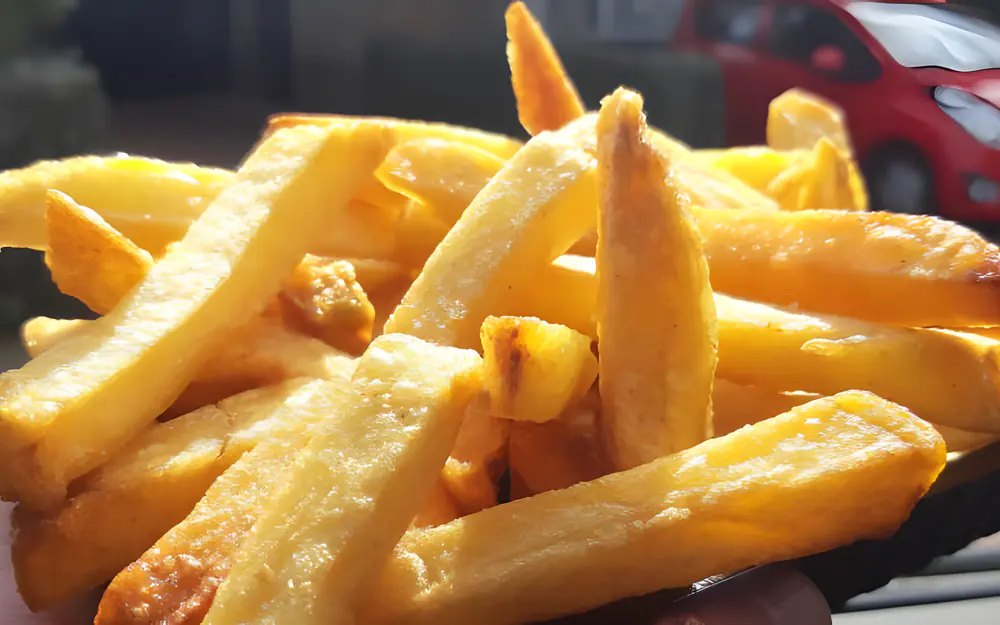
Frying fresh chips calls for a different approach from finishing frozen chips. Fresh chips are raw, cut from real potatoes, and you cook them and make them crisp yourself in two steps. It is a little more work, but the result is a chip with the flavour of the potato and a fluffy centre, which is exactly why many business owners choose fresh. Below you will find the complete frying schedule, with the right frying temperature for each step, the differences from frozen chips and the mistakes we see most often in kitchens.
Frozen chips have already been peeled, cut, blanched, pre-fried and frozen in the factory. In the business you only give them the final fry, straight from the freezer. Some frozen chips contain additives for an even colour or a longer shelf life. Fresh chips are raw cut potato. With us nothing is added: no additives, not pre-fried, just vacuum packed.
That difference affects the frying. Fresh chips contain more moisture, do not yet have a cooked centre and therefore always need a pre-frying step. The two fries each have their own temperature, the times are different and you have more influence on the end result. You will find a detailed comparison of the two products in fresh or frozen chips.
Fresh chips are a fresh product. Keep the sealed packs chilled and only open them when you are about to fry. We cut on Tuesday and Friday mornings and then deliver ourselves, so the chips reach you fresh. Vacuum packing protects the cut potato from air so it does not discolour. How that works is explained in vacuum packed chips, and how to keep the chips in your own cold store in storing fresh chips.
Take the chips out of the pack and let any liquid drain away. If the chips are wet, let them drain briefly in a colander or pat them dry with a clean cloth. Dry chips in the basket mean a calm fryer, a stable temperature and fat that lasts longer. Fill the basket no more than halfway, so the chips have room to cook separately.
Step 1, pre-frying. Set the fryer to about 140 to 160°C; for the usual thickness about 150°C works well. Fry the chips until they are cooked right through, droop and have barely any colour. This takes a few minutes, depending on thickness and quantity. Everything about this step is covered in pre-frying chips.
Step 2, draining and cooling. Let the chips drain and spread them out on a rack or in a perforated tray. Let them cool completely so the surface dries. In a professional kitchen you do these first two steps in advance, in batches, so the cooled chips are ready by the fryer when the first customers come in.
Step 3, finishing. Set the fryer to about 175°C. Fry the pre-fried chips in portions until they are evenly golden and crisp, usually within a few minutes. Shake the basket halfway. Drain, salt in a bowl and serve at once. More tips for these final minutes can be found in finishing chips.
Temperature is not a detail when frying chips. If the fat is too cool during the final fry, the chips turn greasy and limp. If it is too hot during pre-frying, they colour before they are cooked. What is more, a fryer's thermostat does not always show exactly what is happening in the fat. So measure now and then with a separate thermometer and learn how quickly your appliance gets back up to temperature after a full basket.
Keep an eye on the fat itself as well. Fat that is old or too low in the fryer cooks unevenly. Make sure there is enough fat for the quantity of chips, filter it regularly and change it in time. Choose a fat that is suitable for high temperatures and prolonged frying; we are happy to advise you on that too.
Treating fresh chips like frozen. Fry fresh chips in one go at 175°C and you get a dark outside with a raw core. Fresh chips always need two steps. Overfilled baskets. An overfull basket makes the temperature drop too far; the chips stick together and cook unevenly.
Wet chips. Moisture in the basket causes foaming and spitting and shortens the life of your fat. Finishing too hot. Above 175°C the chips colour too quickly and more acrylamide forms. Chips left waiting too long. Pre-fried chips left uncovered for hours and finished chips under the heat lamp both lose their quality.
Mixing up whole potatoes and cut chips. Whole chipping potatoes should be kept cool but not cold, because in the cold room they form sugar and the chips turn blotchy brown. Cut fresh chips, on the other hand, are a chilled product. That difference regularly causes confusion in kitchens that work with both.
Many business owners who move from frozen to fresh need a few weeks to get used to the rhythm of pre-frying and finishing. That is normal. After a few services the routine is in place and you can judge the quantities well. How to make that switch step by step is explained in switching to fresh chips.
We cut our fresh chips from our own Agria and Frieslander potatoes and supply snack bars, chip shops, restaurants, food trucks and events in the central Netherlands. We help you choose the frying fat and fine-tune the way you work in your kitchen. Call or message Thijs on +31 6 23972300, or send us a request.
In two steps: pre-fry at about 140 to 160°C until the chips are cooked, let them cool, and finish at about 175°C until golden and crisp.
Yes. In the first step the inside cooks, in the second the crisp crust forms. Frying in one go gives chips that are too dark outside and not cooked inside.
Frozen chips are already pre-fried and go straight from the freezer into the fryer. Fresh chips are raw: you first pre-fry them at a lower temperature, let them cool and then finish them.
Often because of too much sugar in the potato, for example from storage that was too cold or from immature potatoes. Too high a temperature or old frying fat can also be the cause.
Chilled and in the sealed pack. Only open the pack when you are about to fry, and follow your own food safety plan.
Call or message Thijs or Joost, or compose your request in a minute. You will hear from us soon.
Make a request Get in touchCall or message Thijs on +31 6 23972300 or Joost on +31 6 23055742, or send an enquiry straight away. We are happy to think along with you.
Make a request Call Thijs: +31 6 23972300