
Home
About us
Contact
Make a request
What we supply
Knowledge base
Google rating: 5.0 from 14 reviews★★★★★
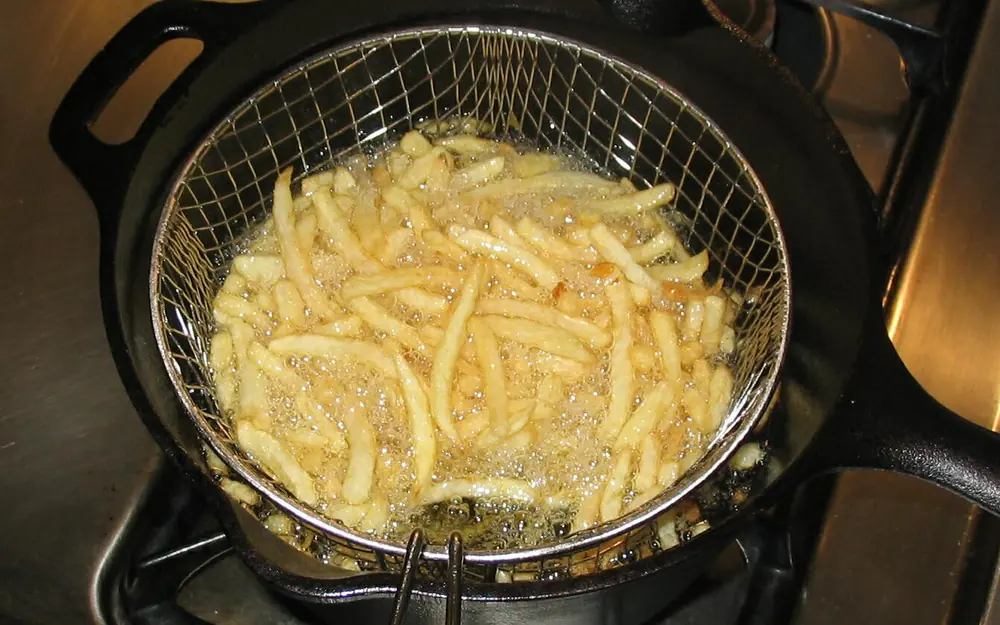
Pre-frying is the step in which a good chip is really made. During the first fry you cook the inside at a low temperature without the outside taking on colour. Only afterwards, in the final fry, does the crisp crust form. If you work with fresh chips, such as the chips we cut from our own potatoes, you always do the pre-frying yourself. Below you can read why, at what temperature and for how long, and how to organise it in the kitchen of a busy business.
A chip has two jobs: to become cooked and fluffy inside, and to get a thin, crisp crust outside. Those two things do not happen well at the same time. Fry a raw chip straight away at a high temperature and the outside is brown before the core is cooked. The result is a chip that is hard outside and raw or glassy inside.
During pre-frying much of the moisture on the outside evaporates and the starch in the core gelatinises. After cooling the surface dries out, and it is exactly that dry surface that turns crisp in the second fry. Pre-frying is therefore not a waste of time but the very reason fresh chips taste so good. You can read more about this principle in frying chips twice.
For fresh chips the pre-frying temperature lies between about 140 and 160°C. The thicker the chip, the lower you go, so the core has time to cook before the surface colours. Thin chips can take the upper end of that range. A practical fixed setting is about 150°C; you then adjust the time rather than the temperature.
Mind the difference between the set temperature and the actual temperature. As soon as you lower a basket of cold, raw chips into the fat, the temperature drops considerably. A powerful fryer recovers quickly, a smaller one needs more time. Check your thermostat now and then with a separate thermometer. For more detail on the right degrees per type of chip, read the right temperature for pre-frying.
There is no fixed time: thickness, quantity, variety, season and your fryer together determine how long it takes. For the usual thickness of about 12 millimetres, count on a few minutes, often between 5 and 8, and establish the right time for your own kitchen with a test portion. Thicker chips need longer.
Rather than watching the clock, watch the chip itself. A well pre-fried chip is cooked right through: press one between thumb and forefinger and it gives without a hard core. It droops when you hold it by one end, is pale and has at most a very faint yellow tint. If there are already brown edges, the temperature was too high or the time too long. The fat gives a clue as well: as the moisture has evaporated from the chips, the bubbling calms down.
Lift the basket out of the fat, let it drain briefly above the fryer and then tip the chips onto a rack or into a perforated tray. Spread them out in a layer that is not too thick. Warm chips lying in a heap keep steaming: the steam cannot escape, the chips turn soggy and stick together.
Let the pre-fried chips cool completely before the final fry. During that time the surface dries and the inside settles. Chips that go into the fat for the second time while still warm end up less crisp. If the chips have to wait longer, keep them covered and chilled, and follow your own food safety plan. What that involves is explained in HACCP and fresh chips.
In a snack bar or restaurant you do not pre-fry per portion but in advance, in batches. The quiet hours before opening are best suited to this. You pre-fry the quantity you expect to need for the coming service, let it cool and keep it ready in trays next to the fryer. During the rush you then only have to do the final fry, which is quick.
Plan the batches around the rush you expect. It is better to pre-fry a smaller quantity twice than one mountain that has to wait too long. Work in a fixed order: what was pre-fried first goes into the finishing basket first. Fill the basket no more than half full when pre-frying, so the temperature does not drop too far and all the chips cook evenly.
A separate fryer for pre-frying and one for finishing makes the work easier, because each stays at its own temperature. If you only have one fryer, pre-fry everything first and then turn the temperature up for the final fry. The fat also affects the result; which types are suitable is covered under the best frying fat.
The most common mistake is pre-frying too hot. The chips then colour in the first step, turn too dark in the final fry and sometimes still stay hard inside. A second mistake is wet chips going into the fat. Water makes the fat foam and spit, lowers the temperature and spoils the fat faster. Make sure the chips are dry before they go into the basket.
We also often see overfilled baskets, chips cooling in a heap and pre-fried chips left standing too long. Skipping the pre-fry almost always leads to disappointment with fresh chips as well. If you are weighing up pre-frying in fat against blanching in water first, read the explanation on blanching chips. Then comes the last step: finishing chips.
Our fresh chips are delivered not pre-fried, so you stay in control of this important moment. If pre-frying in your kitchen is not yet going the way you want, we are happy to help with temperature, method and frying fat. Call or message Thijs on +31 6 23972300, or send a request for fresh chips for your business.
For fresh chips, at about 140 to 160°C. The thicker the chip, the lower the temperature. A practical fixed setting is about 150°C, adjusting the frying time to the thickness and the quantity.
That depends on the thickness, the quantity and your fryer. For regular fresh chips, count on a few minutes. The chips are done when they are cooked right through, droop and have barely any colour.
Until they have cooled completely. The surface then dries and becomes crisper in the final fry. Spread the chips out in a thin layer so the steam can escape.
For the best quality, pre-fry on the day itself, for the service ahead. If the chips have to wait longer, keep them covered and chilled and follow your own food safety plan. Chips that stand for a long time lose quality.
The temperature is too high, or the potatoes contain too much sugar. Turn the fryer down and fry a test portion. If the chips stay blotchy brown, the potato is probably the cause, for example because it was stored too cold.
Call or message Thijs or Joost, or compose your request in a minute. You will hear from us soon.
Make a request Get in touchCall or message Thijs on +31 6 23972300 or Joost on +31 6 23055742, or send an enquiry straight away. We are happy to think along with you.
Make a request Call Thijs: +31 6 23972300