
Home
About us
Contact
Make a request
What we supply
Knowledge base
Google rating: 5.0 from 14 reviews★★★★★
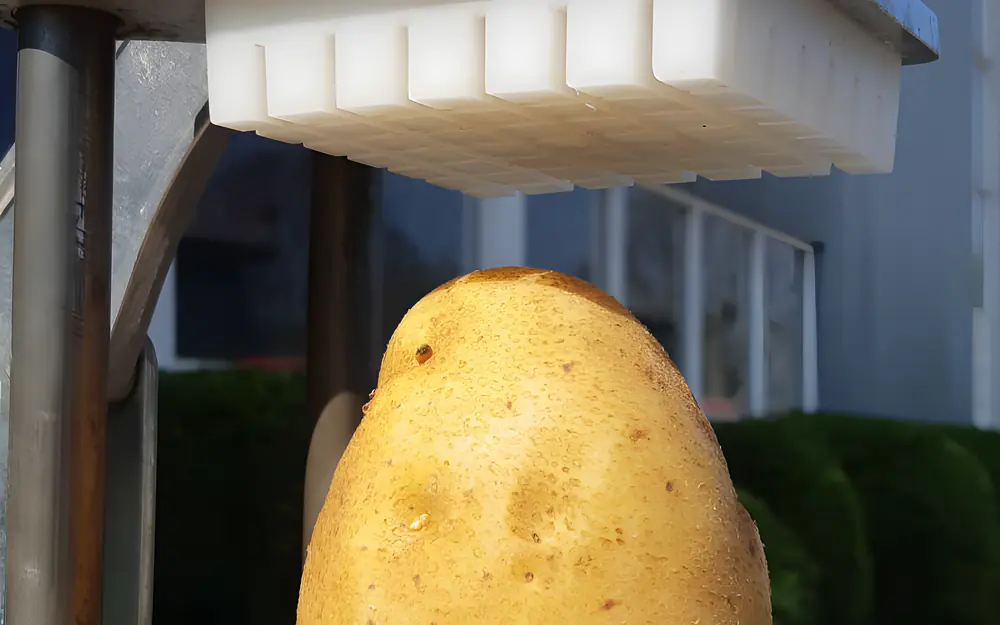
For many snack bars and restaurants a chip cutter is the first step towards fresh chips. But which one do you choose? A manual chip cutter on the wall, or an electric chipping machine that processes the tubers in no time? And does cutting your own actually pay? Friet van Beus started in 2016 because a local chip shop was fed up with peeling and cutting its own potatoes. So we know the trade off from both sides. In this article we set out the choices around a chip cutter for catering.
The best known design is a chip cutter with a long lever that you fix to the wall or worktop. You place a peeled potato in the chamber, pull the lever down and a pusher block presses the tuber through a grid of blades. In one movement out come even sticks. There are also lighter table models with a suction foot or clamp.
The advantages are obvious: a low purchase price, no power needed, little that can break and quick to clean. The drawbacks show up when you are busy. Every tuber goes in one at a time, it takes effort and after an hour of cutting you feel it in your arm. Large tubers sometimes do not fit the chamber and have to be halved first. A manual chip cutter is therefore best suited to small volumes, to a restaurant serving chips as a side, or as a backup next to a machine.
For larger quantities you end up with an electric machine. There are roughly two kinds. In one, a motor pushes the potato through a blade grid, like the manual version but without the muscle power. In the other, the potato drops into a hopper and a rotating disc with blades cuts it into sticks. Many vegetable preparation machines can also be fitted with a chip grid.
An electric machine cuts faster and more evenly, and you can feed the tubers in a continuous flow. On the other hand the purchase costs more, you need power and work space, and the machine has to be taken apart for cleaning after every service. Starch and potato residue left behind are a breeding ground for bacteria. So when buying, also look at how easily the parts come apart.
Manufacturers usually state a capacity in kilos per hour. Those figures are measured in ideal conditions, with a practised operator and an uninterrupted supply of tubers. In practice you often achieve less, because the same pair of hands also has to peel, rinse and fry.
So work back from your own usage. How many kilos of chips go through on your busiest day, and in how much time do they need to be cut? Do you cut everything in the morning, or in small batches during service? A generous margin stops you getting stuck on a Friday evening. And do not forget peeling: a fast chip cutter makes little sense if the peeler is the bottleneck. Read more in potato peelers for catering.
The blade grid decides the thickness of your chips. A thin cut of around 7 millimetres gives quick, crisp fries. The classic Dutch chip is around 12 millimetres. A thicker cut belongs to Belgian chips, and even chunkier pieces are typical of steakhouse chips. Every thickness needs its own grid, so choose a machine on which you can swap easily.
Sharp blades matter more than many business owners think. A blunt blade bruises the potato instead of cutting it. The cut surface turns ragged, more starch is released and the chips take up more fat. Keep spare blades in stock and have them replaced or sharpened in good time. To learn more about how the cut affects the end result, read chip thickness and cut.
Buying a chip cutter is not just about the purchase price. The real cost is in the hours. Add up, for your own business, everything that is involved: buying and storing potatoes, peeling, trimming eyes and blemishes, cutting, rinsing, draining, cleaning the machines and disposing of the waste. Set that against your hourly wage costs.
A simple rule of thumb: if you or a member of staff spends an hour a day peeling and cutting, that is already six hours a week over six opening days. Add the peeling and cutting losses, because you pay for whole potatoes but only fry the chips. Add water, electricity, maintenance and depreciation of the machines, and divide the total by the kilos of chips you sell per week. Then you know what a kilo of your own cut chips really costs.
Compare that with the price of freshly cut chips delivered to your door. For one business cutting your own wins, for example when there are quiet hours in which staff are there anyway. For another, having them delivered is cheaper and calmer. In yield of fresh chips we work out this trade off in more detail.
At Friet van Beus you can go either way. If you prefer to cut yourself, we supply whole Agria and Frieslander chipping potatoes, washed or scraped. Cutting yourself saves costs, and with scraped potatoes you already skip the peeling. See the options under peeled potatoes for catering.
If you want to be rid of the cutting, we cut fresh chips from our own potatoes on Tuesday and Friday mornings, vacuum packed and free of additives, and deliver them ourselves. Just as it began in 2016 with that local chip shop. Not sure? Call or message Thijs or Joost. We are happy to work through the numbers with you.
That varies widely. A manual chip cutter is a relatively small investment, a professional electric machine costs many times more. Compare not only the purchase price but also blades, maintenance and the time cutting takes.
For small volumes a sturdy manual chip cutter with stainless steel blades will do. If you fry large quantities every day, an electric machine is faster and less strenuous for your staff.
The classic Dutch chip is about 12 by 12 millimetres. Thinner gives crisper chips, thicker gives a softer inside, as with Belgian chips.
Yes, rinse the cut chips in cold water to remove loose starch. Then let them drain well and dry before they go into the fat.
That depends on your wage costs, your volume and your waste. Do the sums including all hours and losses. We are happy to think along with you, even if cutting your own from our whole potatoes turns out to be your best option.
Call or message Thijs or Joost, or compose your request in a minute. You will hear from us soon.
Make a request Get in touchCall or message Thijs on +31 6 23972300 or Joost on +31 6 23055742, or send an enquiry straight away. We are happy to think along with you.
Make a request Call Thijs: +31 6 23972300