
Home
About us
Contact
Make a request
What we supply
Knowledge base
Google rating: 5.0 from 14 reviews★★★★★
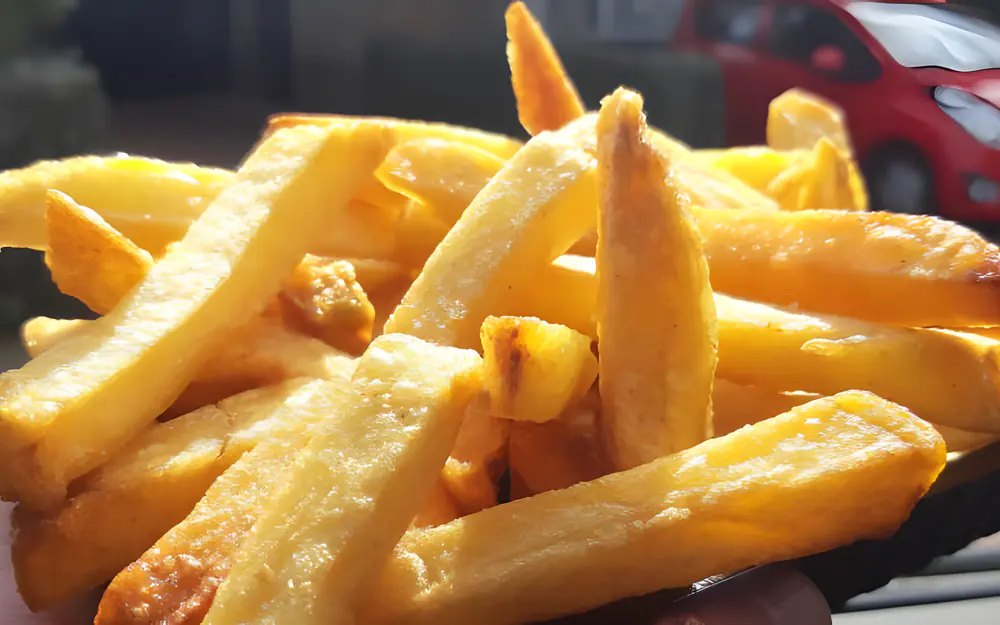
The margin on fresh chips is a question every owner asks before switching. Fresh chips take more handling than frozen ones, so they need to bring something in. Whether fresh chips are profitable for your business depends not only on the purchase price, but on everything that happens afterwards: in the kitchen, at the counter and in your customers' minds. Below are the factors that make the difference, without calculations that would not fit your own business anyway.
In many villages and neighbourhoods there is more than one place selling chips over the counter. If everyone fries the same industrial chips from the same freezer, there is little to compete on except price. Fresh chips from a recognisable grower give you a story: potatoes from the family's own land in Zeewolde, cut on Tuesdays and Fridays, with nothing added. You can tell that story on your menu, in your window and on social media.
A product that stands out gives you room in your pricing. Customers who notice that your chips taste different are less quick to compare you with the place round the corner. That is where much of the margin lies: not in what you save, but in what you can charge. How snack bars approach this is covered under fresh chips for snack bars.
With fresh chips, the quality of the potato decides how many usable chips you end up with. Large, well-graded potatoes with plenty of dry matter give long chips, few breakages and little moisture in the fryer. A watery potato shrinks more and absorbs more fat. A fixed growing schedule with the same varieties throughout the year makes that yield predictable, and you see it reflected in your purchasing.
Customers eat the chips, not the weight on the delivery note. Chips that are fluffy inside and crisp outside make a portion look generous without you having to add more. Which variety works best for that is explained under which potato for chips.
Waste arises where stock and demand do not match. With two fixed delivery days a week you order in smaller amounts and keep your cold room clear. You store vacuum-packed chips cold and sealed, and each shift you open only what you need. How to handle that in the cold room is explained under storing fresh chips.
Then there is labour. Peeling and cutting potatoes yourself takes hours, space and a machine; that is exactly why a local chip shop approached the Van Beusichem family in 2016 and Friet van Beus was born. With ready-cut fresh chips that work disappears and only the frying remains. If you still prefer to cut your own, you save on purchasing but pay in time. Which option works out better depends on your staff and your volume. If you are considering cutting your own, read buying a chip cutter first.
The most expensive customer in any catering business is the one who does not come back. Chips are often the product a business is judged on, even when someone really came for a snack. A portion that always tastes the same and looks fresh builds a base of regulars. They come more often, order more and bring others along.
Not sure whether fresh chips suit your business? Talk it through with Thijs on 06 23972300, or send us a request. Together we will look at your kitchen, your busy periods and your menu. If you are considering the step, you will find a practical plan under switching to fresh chips.
That differs per business and depends on your purchasing, your selling price, your staff and your volume. There is no figure that holds for everyone. We are happy to think through your own situation with you.
A little more, because you do the pre-frying yourself. The peeling and cutting has already been done. With a good frying routine it is perfectly manageable at busy times.
Many owners mention the origin on their menu. Whether and by how much you adjust your price is your own decision, but the story of fresh chips straight from the farm certainly gives you reason to.
Match your order to the two delivery days, keep the packs cold and sealed and open only what you need for that shift. Pre-fry a suitable amount ahead of the rush rather than everything at once.
Call or message Thijs or Joost, or compose your request in a minute. You will hear from us soon.
Make a request Get in touchCall or message Thijs on +31 6 23972300 or Joost on +31 6 23055742, or send an enquiry straight away. We are happy to think along with you.
Make a request Call Thijs: +31 6 23972300