
Home
About us
Contact
Make a request
What we supply
Knowledge base
Google rating: 5.0 from 14 reviews★★★★★
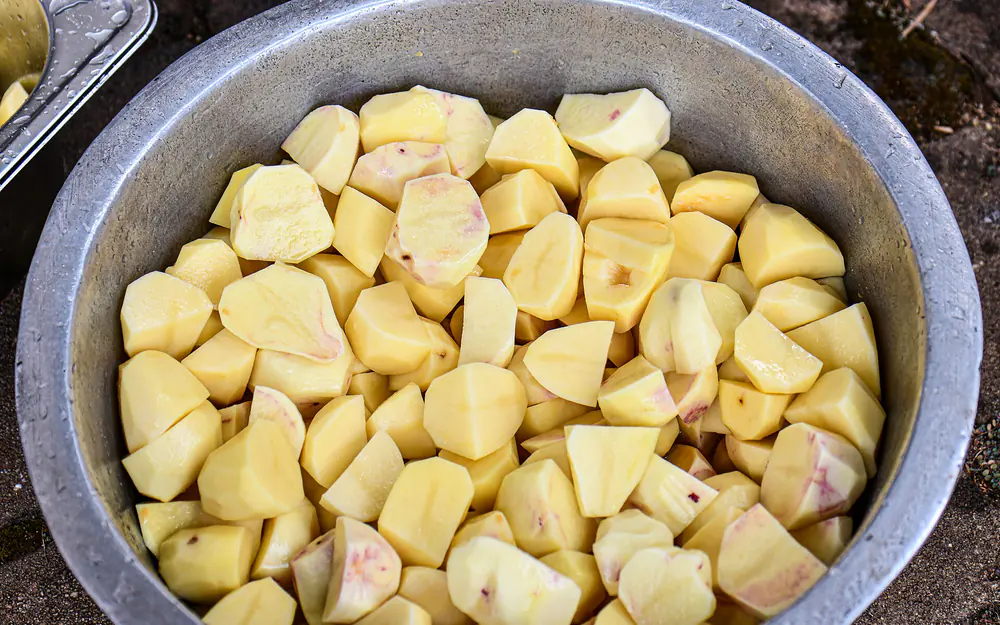
Floury potatoes are potatoes that break down slightly when cooked and develop a dry, crumbly centre. They are loved for mash and stews, and for chips they are indispensable. As a grower in Zeewolde and a supplier of fresh chips, we work with floury varieties every day. In this article we explain exactly what floury means, how the cooking classes work, which varieties are floury and why a floury potato gives chips that are crisp outside and fluffy inside.
Whether a potato is floury depends mainly on its starch content. A potato is made up of cells filled with starch granules. When heated, these granules absorb water and swell. In a potato with a lot of starch the cells swell so much that they come apart. The result is a dry, loose and crumbly texture: floury.
With a waxy potato this happens far less. It contains less starch and more water, the cells stay stuck together and the potato keeps its shape after cooking. So you only really see and feel the difference once it is cooked. From the outside of a raw potato you can hardly tell. Flouriness is a property of the variety, added to by the influence of growing conditions, soil and weather.
To indicate how a potato behaves when cooked, growers and the trade in the Netherlands use cooking classes. They run from A to D. Cooking class A is waxy: the potato stays whole and is firm and moist. Class B is fairly firm, with a slightly floury texture. Class C is floury. Class D is very floury: the potato falls apart easily when boiled.
There are intermediate forms between the classes, such as BC for a potato that sits between fairly firm and floury. The cooking class is a property of the variety, but not an exact science: the same potato can turn out more floury in a dry year than in a wet one. For chips you generally want a potato around classes B and C: floury enough for a fluffy centre, firm enough not to break.
In everyday Dutch, the words for floury and very floury are often used interchangeably. Strictly speaking, very floury is the strongest form: a potato that really falls apart when boiled. For mash that can be ideal, for chips it is too much of a good thing. Very floury potatoes can break during cutting and frying and sometimes turn dry or hollow. You can read more about this group in our article on very floury potatoes.
At the other end are the waxy potatoes. They are perfect for salads, sautéed potatoes and dishes in which the potato has to keep its shape. For chips they are less suitable: they contain more water, do not become fluffy in the fryer and never get a proper crisp crust.
Some well known floury varieties in the Netherlands: Agria, large and elongated with deep yellow flesh, the benchmark for many chip fryers. Frieslander, an early variety with white-yellow flesh that is ripe as early as late summer. Bintje, the classic Dutch variety that was the standard for chips for generations; read more under Bintje potatoes. And Bildtstar, a floury variety from Friesland that is also used for chips and mash.
On the very floury side is Eigenheimer, an old variety known as a truly floury potato that comes into its own in mash and traditional Dutch stews. Varieties such as Annabelle and Charlotte, by contrast, are on the waxy side. A broader overview of varieties and their uses can be found under potato varieties.
If you are looking for a floury potato for chips, you are really looking for the right balance between water and starch. Plenty of starch means little water. Less moisture then has to evaporate in the fryer, so the surface dries and crisps up faster. At the same time the inside turns soft and fluffy during pre-frying, exactly the chip the customer expects.
A potato high in dry matter also absorbs less fat. Chips made from a floury potato therefore feel less greasy and stay crisp for longer after frying. A waxy potato does the opposite: the chips stay glassy, collapse and soak up more fat. How to choose the right chipping variety is described in which potato for chips.
Flouriness alone is not enough, by the way. A good chipping potato is also low in sugar, otherwise it browns too quickly in the fryer. And it has to be large and elongated enough to cut attractive, long chips from. Agria combines these qualities, which is why we cut our fresh chips from it for most of the year.
Not sure whether a batch is floury? Cut a potato in half. A floury potato feels dry on the cut surface and often leaves a white film of starch on the knife. An old kitchen trick is to put the potato in a strong salt solution: floury potatoes, with plenty of dry matter, sink more readily than waxy ones. The most reliable test is still boiling or frying: a floury potato turns dry and slightly crumbly once cooked.
Store floury potatoes dark, dry and cool, but not too cold. Below about 6°C a potato starts converting starch into sugar, making it taste sweetish and brown in the fryer. In the light, potatoes turn green. The full explanation is in storing potatoes.
Are you looking for floury potatoes for the chips in your snack bar or restaurant, or for your wholesale business? We supply Agria and Frieslander from our own crop, as fresh chips or as whole potatoes: washed, peeled or unpeeled. For questions about varieties and growing, call or message Joost on +31 6 23055742; for orders, Thijs on +31 6 23972300.
Potatoes with a lot of starch and little water, which break down slightly when cooked and develop a dry, crumbly centre. They fall into cooking class C, with intermediate forms towards B or D.
Well known floury varieties include Agria, Frieslander, Bintje and Bildtstar. Eigenheimer is very floury. Varieties such as Annabelle and Charlotte are waxy.
Yes, flouriness is the basis of good chips. Thanks to the high starch content, the chips turn crisp outside and fluffy inside. Do choose a variety that is low in sugar and elongated in shape, such as Agria.
Very floury is the strongest form of floury. A very floury potato really falls apart when boiled. Floury is slightly firmer, and that is usually the better choice for chips.
It has probably been stored too cold. Below about 6°C a potato converts starch into sugar. You can taste it, and you see it in the fryer as chips that are too dark.
Call or message Thijs or Joost, or compose your request in a minute. You will hear from us soon.
Make a request Get in touchCall or message Thijs on +31 6 23972300 or Joost on +31 6 23055742, or send an enquiry straight away. We are happy to think along with you.
Make a request Call Thijs: +31 6 23972300