
Home
About us
Contact
Make a request
What we supply
Knowledge base
Google rating: 5.0 from 14 reviews★★★★★
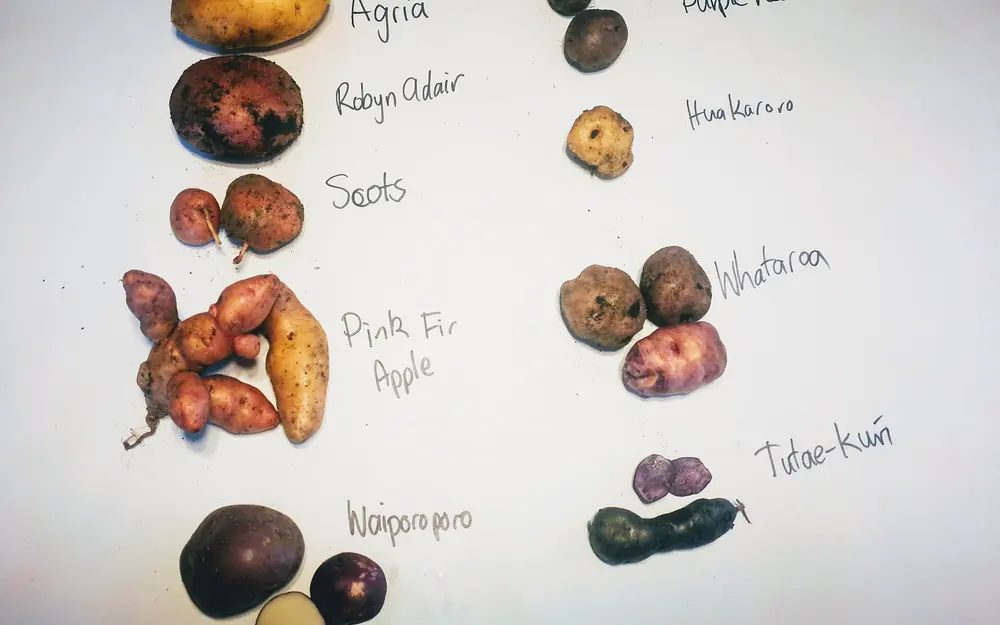
Dozens of potato varieties are grown in the Netherlands and each has its own character. One cooks firm, another falls apart. One fries golden yellow, another browns quickly. For a catering business that is no minor detail, because the variety decides how your chips, mash or salad turn out. Below we list the best known potato varieties, with their cooking type and where they perform best in the kitchen. With extra attention to varieties for chips, since that is what we as growers know most about.
The cooking type is the best known characteristic: waxy (A), fairly waxy (B), floury (C) or very floury (D). It tells you something about the dry matter content and therefore the texture after boiling or frying. But there is more. Shape and size decide how many long chips you get from a tuber. Shallow eyes make peeling easier and reduce waste. Flesh colour ranges from white to deep yellow. And the sugar content decides whether a potato stays golden in the fryer or browns quickly.
Finally, storability counts. Some varieties are bred for the early harvest and need to be used quickly, others keep well for months in a store. For a chip shop that wants the same quality all year, this may well be the most important point.
Agria is the benchmark for many chip fryers. The variety has large, elongated tubers with shallow eyes and deep yellow flesh, and cooks slightly floury to floury. That gives long chips with a golden colour, a crisp outside and a full flavour. Agria stores well, so it will see you through a large part of the year. Read more about this variety on our page about Agria potatoes.
Frieslander is an early variety with white-yellow flesh and a slightly floury texture. Because it is available early in the season, it is popular as a chipping potato in late summer, when the old crop runs out and the storage varieties of the new crop still need to mature. It is also a fine potato for boiling and roasting.
Bintje is the classic among chipping varieties. It was bred in Friesland more than a hundred years ago and is still the best known chipping potato in Belgium. Bintje cooks floury and gives flavourful chips, but the variety is susceptible to disease and is therefore grown less than it used to be. More on that in our piece about Bintje potatoes.
Innovator is a variety grown mainly for the chip processing industry. The tubers are large and elongated with a light skin, and cook fairly waxy to slightly floury. Low sugar levels and an even shape make it suitable for frozen chips on a large scale. In a fresh chip shop you come across it less often.
Bildtstar takes its name from the Bildt area in Friesland and is a household name in the north of the country. It cooks fairly waxy to slightly floury, depending on soil and season, and is widely usable: boiling, roasting and chips too. To learn more, read our article on Bildtstar potatoes.
Eigenheimer is one of the oldest varieties still grown in the Netherlands, dating back to the late nineteenth century. It is a distinctly floury potato with plenty of flavour. Ideal for stamppot and mash, but fragile, both in the pan and in the cutter. For chips on a catering scale you would therefore usually choose a sturdier variety.
Doré is one of the first new potatoes of the year. The variety has a thin skin and cooks floury, which makes it good for mash and stamppot. As an early variety it keeps for a shorter time than the storage varieties, so it is best bought fresh.
Première is also an early variety, with oval tubers, a smooth yellow skin and shallow eyes. It cooks slightly floury and is used mainly in early summer as a chipping potato. As with other early varieties, quality depends heavily on when it is lifted: lifted too early, the tuber is still watery and the chips brown faster.
Nicola is the textbook waxy potato, cooking type A. The elongated tubers with yellow flesh stay whole after cooking, which makes them ideal for potato salad, sautéed potatoes and gratins. Nicola is not suitable for chips: too much water and too little dry matter. We explain why in our piece on waxy potatoes.
A handy summary for the kitchen: Agria, Bintje, Frieslander and Première for chips. Doré and Eigenheimer for mash and stamppot. Bildtstar as an all rounder. Nicola for salad and sautéed potatoes. Innovator mainly in industry.
On our farm in Zeewolde, where we have been growing since 1994, we raise the potatoes for our own fresh chips. From September to July that is Agria, because this variety stores well and gives consistent quality. In August, the transition season, we switch to Frieslander for a few weeks, an early variety that is at its best at that time, fries crisp quickly and keeps well. After that the new Agria are often good enough. That way you get chips all year round from a variety that is in top form at that moment. How the two compare is explained in Agria or Frieslander.
Because we only process our own potatoes, there is hardly any difference in the chips throughout the year. You can choose fresh chips, vacuum packed and free of additives, or whole chipping potatoes to cut yourself. Would you like to come and see the farm? You are welcome. Call or message Thijs or Joost to arrange a visit.
For fresh chips Agria and Bintje are the best known choices, with Frieslander and Première as early alternatives. What matters is a floury to slightly floury variety with plenty of dry matter and little sugar.
There are thousands of potato varieties worldwide. In Dutch shops and catering you only come across a handful, such as Agria, Bintje, Frieslander and Nicola.
Early varieties such as Doré, Première and Frieslander are lifted early in the season and are meant for quick use. Storage varieties such as Agria build up more dry matter and keep for months when stored dark, cool and dry.
Yes, although Bintje is grown less than it used to be because it is susceptible to disease. Many chip fryers now work with varieties such as Agria, which give similar chips with more stable quality.
Well known waxy varieties are Nicola, Annabelle, Charlotte and Roseval. They suit salads and sautéed potatoes, not chips.
Call or message Thijs or Joost, or compose your request in a minute. You will hear from us soon.
Make a request Get in touchCall or message Thijs on +31 6 23972300 or Joost on +31 6 23055742, or send an enquiry straight away. We are happy to think along with you.
Make a request Call Thijs: +31 6 23972300