
Home
About us
Contact
Make a request
What we supply
Knowledge base
Google rating: 5.0 from 14 reviews★★★★★
Ask a Belgian chip shop owner about the best chipping potato and there is a good chance the answer will be Bintje. In Belgium, bintjes are almost a synonym for good fries, and in the Netherlands everyone knows the name too. Yet Bintje is a Dutch variety by origin, from Friesland no less. Here you can read the history of the Bintje potato, why it is so popular for chips and how it compares with Agria, the variety we cut our chips from for most of the year.
Bintje was bred by Kornelis Lieuwes de Vries, a schoolmaster from Suawoude in Friesland who crossed potato varieties in his spare time. A cross between the varieties Munstersen and Fransen, made in 1904, produced a seedling that he went on to select. The variety came onto the market around 1910. De Vries named his varieties after pupils, and this one was given the name of Bintje Jansma.
What began as a hobby grew into one of the best-known potato varieties in the world. Bintje was grown on a large scale in the Netherlands for decades and crossed the border into Belgium, France and far beyond. For a variety more than a hundred years old that is exceptional: most varieties disappear from the fields again after a few decades.
Bintje has a yellow skin, pale yellow flesh and an oval to elongated shape. It is a floury potato: when boiled it falls apart easily, and in the fryer it gives a dry, fluffy centre. That quality makes Bintje so suitable for chips and mash, and less so for dishes where the potato has to stay whole. There is more on this under floury potatoes.
The old variety has drawbacks too. Bintje is susceptible to disease, particularly late blight (phytophthora), and therefore needs a lot of care and crop protection in the field. In storage it is prone to sweetening at low temperatures: sugars build up, and sugar-rich potatoes darken faster in the fryer. For chipping potatoes, good storage that is not too cold is therefore extra important.
In Belgium, Bintje is woven into the chip culture. Generations of chip fryers learned their trade with it and many Belgians grew up with it. The flavour is mild and familiar, the inside fluffy and the crust nicely crisp after frying twice. Anyone in Belgium buying potatoes to fry frites still comes across the name Bintje regularly.
That preference is also a matter of habit and trust. A chip shop that has worked with Bintje for years knows exactly how the variety behaves: how long the pre-fry takes and at what colour the chips are done. Another variety calls for adjustment. More on the Belgian method can be found under Belgian fries.
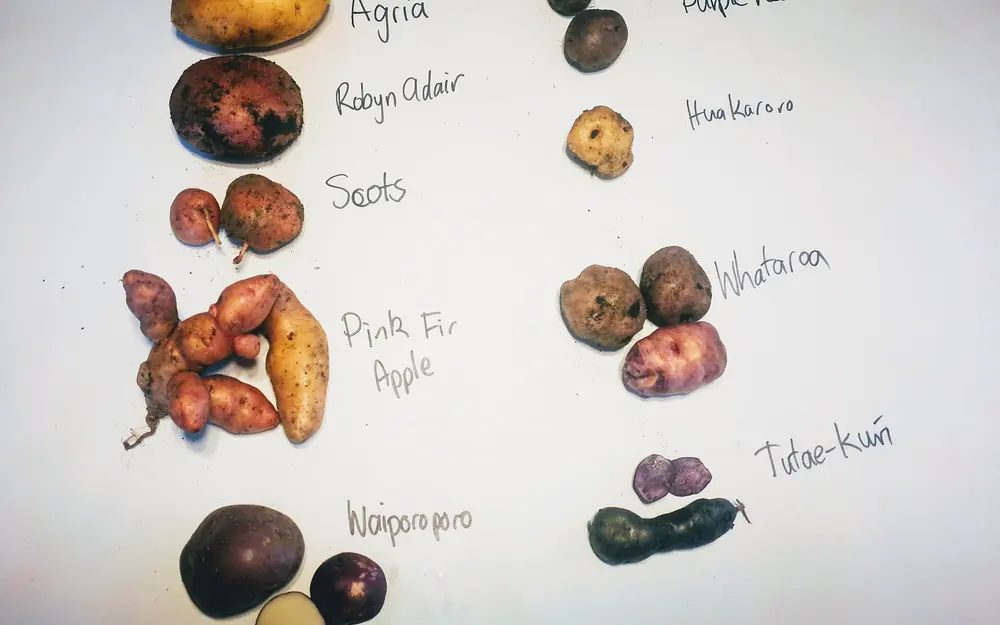
Agria is a German variety that came onto the market in the 1980s and is widely used for fresh chips in the Netherlands, Germany and Belgium. Where Bintje is pale yellow, Agria has deep yellow flesh, which gives warm, golden chips in the fryer. The tubers are large and long oval, so you can cut long sticks from them with little waste. The dry matter content is high, just as with Bintje, so Agria also turns floury inside.
Both varieties give chips with a soft centre and a crisp crust. The differences lie mainly in colour, tuber size and cultivation: Agria is less susceptible to disease than Bintje and stores well, so consistent quality is available for much of the year. A broader comparison can be found under potato varieties.
At Friet van Beus we do not grow Bintje. From September to July we cut our chips from Agria, and in the transition season, for a few weeks in August, from Frieslander, an early variety with a floury texture. We make that choice because we want to supply fresh chips from our own potatoes all year round, with as little variation in quality as possible. Why we switch in this way is explained under Agria or Frieslander.
Do you currently work with Bintje and wonder how our Agria behaves in your fryer? We are happy to think along about the switch, the fat and the frying times. Call or message Thijs on 06 23972300 or Joost on 06 23055742.
The Frisian schoolmaster Kornelis Lieuwes de Vries, who bred the variety, named it after one of his pupils, Bintje Jansma.
Yes. Bintje is floury and gives a fluffy centre and a crisp crust. It has been a classic chipping potato for over a century, especially in Belgium.
Bintje has pale yellow flesh, Agria deep yellow. Agria has larger, longer tubers and is less susceptible to disease. Both are floury and suitable for chips.
Mainly because of its susceptibility to diseases such as late blight, which makes it demanding to grow. Newer varieties are more robust and often produce larger tubers.
No. We grow and cut Agria and, in August, Frieslander. Both varieties are floury and suitable for chips.
Call or message Thijs or Joost, or compose your request in a minute. You will hear from us soon.
Make a request Get in touchCall or message Thijs on +31 6 23972300 or Joost on +31 6 23055742, or send an enquiry straight away. We are happy to think along with you.
Make a request Call Thijs: +31 6 23972300