
Home
About us
Contact
Make a request
What we supply
Knowledge base
Google rating: 5.0 from 14 reviews★★★★★
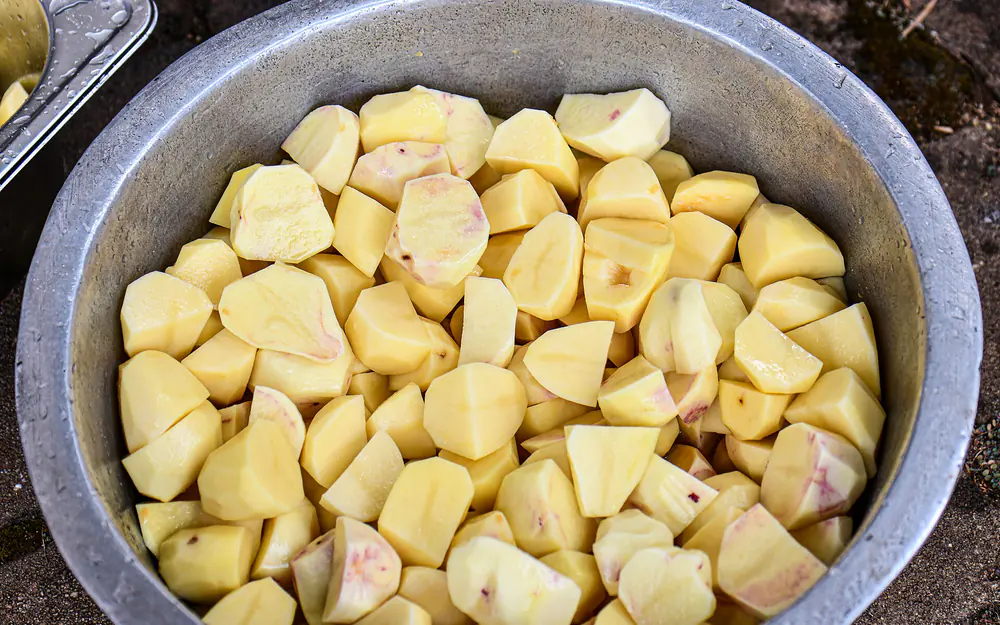
A floury potato falls apart into dry, soft crumbs once cooked and mashes without any effort. For mash that is exactly what you want. But what about chips? As growers in Zeewolde we are asked this regularly by catering businesses. In this article we explain what makes floury potatoes floury, how the cooking types work, how floury differs from kruimig and when a floury potato does or does not belong in the chip cutter.
The difference lies in the starch. A potato is mostly water. The rest is called dry matter, and most of that is starch. The higher the dry matter content, the more floury the tuber. During cooking the starch granules swell and the cells come apart. The flesh turns dry, fluffy and grainy. In a waxy potato the cells stay bound together and the flesh keeps its shape.
On the farm we measure this with the underwater weight: a fixed quantity of potatoes is weighed under water. The heavier they are under water, the more dry matter they contain. The variety largely decides where a potato ends up, but not entirely. Soil type, weather, fertilisation and the moment of lifting all play a part. After a dry, sunny summer the same potatoes are often more floury than after a wet season. A sack labelled floury is therefore not a law of nature, but an average.
To keep things clear, potatoes are divided into cooking types. Type A is waxy: the tuber stays whole and feels smooth and firm. Type B is fairly waxy, with a slightly crumbly outside. Type C is floury: the tuber partly falls apart during cooking. Type D is very floury and breaks up quickly if you do not keep an eye on it.
On retail packaging you usually see words rather than letters: waxy, slightly floury and floury. Slightly floury sits roughly between B and C. For a professional kitchen that middle category is the interesting one, because it holds many varieties that fry well. If you want to know more about the opposite end of the scale, read our piece on waxy potatoes.
In practice most people mean the same thing. In the Netherlands the usual word is kruimig, in Flanders you hear bloemig more often. Both describe a potato that falls open after cooking and feels dry. If you want to be precise, bloemig is used for the far end of the scale, potatoes that fall apart almost into flour, and kruimig for a tuber that breaks open nicely but keeps some structure.
For your purchasing, that difference does matter. A very floury potato is lovely in mash but awkward in a chip cutter. A floury to slightly floury potato is more versatile. Our article on kruimig potatoes goes into this in more depth.
Floury potatoes shine in dishes where the potato is allowed to blend into the whole. Think of mash, Dutch stamppot, potato soup that you want to thicken, jacket potatoes from the oven and homemade croquettes or gnocchi. The dry flesh absorbs butter, milk or gravy well, so a mash turns creamy without becoming watery.
A few kitchen tips. Start floury potatoes in cold, lightly salted water and let them simmer rather than boil hard, otherwise the outside breaks up before the centre is cooked. Drain them well and let them steam dry in the pan for a moment. For salads, sautéed potatoes or a gratin with neat slices, a firmer type is the better choice.
In a professional kitchen it pays to keep floury potatoes for mash separate from your chipping potatoes. That way every dish gets the potato it needs, even when a stand-in is working the kitchen.
Yes, with one caveat. For good chips you want a potato with a high dry matter content. Less water means the chip forms a crisp crust sooner, stays fluffy inside and takes up less fat. That is why the well known chipping varieties are floury to slightly floury. A watery, waxy tuber gives limp chips that sag in the tray.
Go to the far end of the scale, however, and you run into other problems. Very floury potatoes break more easily in the cutter, give ragged edges and leave more crumbs in the frying fat. Those crumbs burn and wear the fat out faster. Chips from an extremely floury tuber can also turn dry and mealy inside. The ideal chipping potato therefore sits just below the top: floury enough for a fluffy centre, firm enough to stay whole.
Besides dry matter, sugar content counts. A potato with a lot of sugar browns quickly in the fryer and tastes bittersweet, however floury it is. Which varieties come out best is covered in our article which potato for chips.
For a snack bar or restaurant the cooking type matters, but what matters most is that it is the same every week. That is why we grow our chipping potatoes ourselves. From September to July we cut Agria potatoes, and for a few weeks in August the Frieslander. Because we only use our own potatoes, there is hardly any difference in the chips throughout the year.
You can come to us for fresh chips, vacuum packed and free of additives, or for whole potatoes: washed or scraped. Would you like to know which potato suits your kitchen and your fryer best? Call or message Thijs or Joost, or send us a request. We are happy to think along with you.
In everyday use, yes. Kruimig is the usual Dutch term, bloemig is heard more in Belgium. Strictly speaking bloemig stands for the far end of the scale: potatoes that fall apart almost into flour.
Floury potatoes fall into cooking type C or D. Type C is floury, type D very floury. Waxy potatoes belong to type A, fairly waxy ones to type B.
Yes. Chips actually need a potato with plenty of dry matter. Do choose a floury chipping variety rather than an extremely floury type, because those break easily when cut and leave more crumbs in the fat.
A well known rule of thumb: cut a raw tuber in half and rub the halves together. If they stick and a white, milky liquid appears on the cut surface, it contains plenty of starch. After cooking you can see it straight away: the skin bursts and the flesh falls apart into crumbs.
Dry matter content also depends on the growing season, the soil and the moment of lifting. After a dry summer potatoes are usually more floury. That is why working with one grower and their own fields is convenient: you get fewer surprises.
Call or message Thijs or Joost, or compose your request in a minute. You will hear from us soon.
Make a request Get in touchCall or message Thijs on +31 6 23972300 or Joost on +31 6 23055742, or send an enquiry straight away. We are happy to think along with you.
Make a request Call Thijs: +31 6 23972300